Friday, September 12, 2014

London, Day 1 (7/31/14)

It's been over a month and a half since I spent my first day in London (and in Europe!), but I wanted to make sure to post some pictures from that day!

From my British Airways seat:

I was fascinated by how tiny the Sprite can was!

The windows didn't have covers; instead, they had tints that actually worked very well and you could adjust how much sunlight you wanted to let in on a gradient

This came with my meal, and since I didn't know that the flight attendants would come by afterwards to offer us tea or coffee, for which we could use this milk, I just drank it.

As soon as I landed,  I had a weird interaction with the customs agent. He was very skeptical of everything I was telling him, and told me to reconsider Ghana because Ebola was there already. I was pretty sure it wasn't (though I hadn't checked in a couple days, so I couldn't say for sure), but everything he said just seemed so judgmental that I wanted to get out of there as soon as possible. I went directly on the Connect train from Heathrow to London Paddington. It took me forever to figure out how to get there and use the train, but I eventually figured it out. I was fortunate that my hostel was within reasonable walking distance of the Paddington train station, so I walked to it to check in and leave my luggage down. I then proceeded to try to find the Marble Arch and Hyde Park (Tip for people interested in London: you really don't need any cash, especially with a credit card that doesn't charge a foreign transaction fee. If you feel more comfortable with cash, just wait until you get into London and walk to any place that has a cash-exchange place because you will get a significantly better deal exchanging there, especially because of the competition):


I was ridiculously exhausted from the flight, and definitely jet-lagged, so I found a random bench in Hyde Park and laid down for a little bit. From a pamphlet that I'd picked up in the hostel, I knew that there would be a free tour of the East side of London in the afternoon, so I made my way there. Keep in mind that this navigation is testing my map-reading like nothing else ever has before and that my feet were hurting the way that only happens when you travel to a city in which everything is within walking distance. 

On the tour, I actually met three other Longhorns - one alumnus and two who had just finished up studying abroad in Spain. Awesome!

Anyways, we walked past Buckingham Palace:


And then saw the British army people guarding Prince Harry's house (they perform a short walk every ten minutes to keep their blood flowing)


And then a couple of just pretty buildings that we walked past:


I also snuck some pictures of Westminster Abbey and Big Ben!


And a look at the iconic phone booths of London:


By this time, my feet are killing me. Nevertheless, I am too chicken to try to figure out how to use the subway system, so I end up trying to walk back to my hostel. I'm not bad with directions and maps, never have been, but the lack of cellular data is daunting. Since I don't want to spend the money to get a taxi, though, I head back towards Buckingham Palace. Along the way, there are several gorgeous sights:


I stayed in front of Buckingham Palace for a long time to give my feet another rest, and then head back to the hostel. 


By the time I get back, I'm thoroughly exhausted, but I know that I have to plan out the next day so that I'm not wandering around aimlessly with a bunch of time that I end up wasting. The hostel is decent, but definitely not a hotel. I chose a room with 8 people; all the beds were occupied, but people were respectful of the space, keeping to themselves and keeping quiet. There's only one bathroom and it's tiny, but I couldn't have expected much more than that for the price I paid. Overall, good first day in the city!

Monday, September 1, 2014

HCMP: Non-compliance in Patients

I attended my first meeting with the Health Careers Mentorship Program, a student organization that I was accepted to last semester. The purpose is to expose students to shadowing opportunities of health professionals and other health-related information. An alumnus of UT and HCMP and current 3rd-year medical student at UTMB, Angie, is hosting a discussion series for us about some of the ethical issues in medicine to help prepare us for the realities of our chosen career paths, and today's was non-compliance in patients.

The issue revolves around the fact that a major problem in medicine is that patients will refuse to take their medications and otherwise not follow a doctor's suggestions about their health, for various reasons. We talked about a lot of them (e.g. finances, feeling better, etc.), but the most interesting one for me was about side effects of many medications. There are several examples of medications that make patients gain weight, feel drowsy, or other things that, on paper far outweigh the prospect of being cured from a serious condition but in reality can be major reasons for patients to stop taking medications even if they are still experiencing symptoms.

My mother always tells me about the benefits of Chinese Medicine - her profession - because acupuncture and herbal treatments don't have side effects. Her knowledge is the reason that the last time I took medication was about two years ago and only because I had dental work done and was painful to the point that I couldn't take it anymore. I still have the otherwise-full bottle of aspirin. I literally haven't taken anything else since, and I believe that I hadn't taken any drugs for a couple years prior to that as well.

When I think about having to prescribe these medications to patients, which can cause them headaches, diarrhea, skin irritation, drowsiness, weight gain, or more severe symptoms such as seizures, blindness, and sleep driving, I'm not sure about that. I want to work in health - there's no Plan B - but if I know how effective Chinese Medicine can be, even in cases of cancer (my little brother Justin was cured of childhood leukemia with it), how can I dish out medications that I haven't used myself in something like 10 years?

Wednesday, August 27, 2014

Ghana Day 22; 8/24/14

As I’m sitting by myself at the gate for my flight tonight, I can’t help but think that coming here was  one of the coolest experiences and best decisions that I’ve ever made in my life. I’ll keep the final reflection of the trip on another post, but I’m so very grateful for the opportunity I’ve had and the relationships I’ve built in just three short weeks.

I passed out on the second half of our bus ride to Accra because I went to sleep really late last night, but one thing that I immediately noticed was the difference in wealth distribution in the city as opposed to the country, where most of our work was done. At the beginning, we saw cows that were so thin we could see almost all their ribs. 


When we got to Accra, we passed by several of the embassy houses after dropping off two of the interns with early flights, and the embassy houses were absolutely beautiful. I wasn’t able to get as many pictures as I would have liked from the moving bus, but it was so interesting to see what an affluent country like Canada could do with the land and resources it had in a developing country. We also passed by the White House-equivalent of Ghana, which was 100% beautiful. It was so classy and looked like a simple structure but obviously had a lot of complexity to the architecture, and it was in the middle of an otherwise barren land, so it drew a lot of attention.


We ended up going to one of the markets around town for the early afternoon, which reminded me way too much of a Taiwanese night market, but with tighter hallways. When we stepped off the bus, we were immediately greeted by a bunch of shopkeepers (interestingly all men) that came and started pairing with us one-on-one. It was very intimidating at the beginning, but they were just trying to be very friendly so they could take us to different shops to buy their items. There were so many things to choose from – lots of things like bags and bracelets that we saw in Cape Coast, and then lots of things that we didn’t see, including little sculptures. It was fun to be able to look, and I ended up spending a good bit of my remaining money buying a painting, some bracelets (and one made with tiny beads with flags of all the countries in the US and Ghana World Cup bracket, as well as the Brazilian flag! It was made by a guy named John who claimed it took 30 days to make, which seems excessive to me, but it really is high quality), and a small horse made of ebony wood. I’m extremely excited to gift them to people and keep some to myself!

We then made our way to the main mall of Accra. It was comparable to a mall you might see at in a smaller city in the US, and I wasn’t the only intern that found it a little off-putting that there were other foreigners in the area. It’s funny how time as short as three weeks can change your perspective and your perception of the norms of life. There were TVs showing a PSA about Ebola awareness, the same that I’d seen from the TV at Aaba lodge, which is great to see as a public health major.

We split in two groups and I ended up going to the chicken restaurant in the food court to order a chicken sandwich, which was delicious. I can’t wait to get some typical food again; rice, beans, noodles, fruit, and tomatoes are great, but it’s difficult to eat the same thing for so many days in a row.

We then split up even further because some people decided to get the 25GHC manicures (that’s less than $8), and I didn’t think I needed it. Instead, I walked with two other interns to explore the grocery store on one side of the mall and the Target or Walmart-style store on the other. It reminded me of how much excess there is in the United States, especially in supermarkets; a typical HEB/Trader Joe’s has more selection and stock than what I assume to be one of the biggest malls in Ghana.
Since we couldn’t really pay with anything with credit card, there wasn’t much point in browsing the clothing stores any further; the book store seemed to have all kinds of products, including a significant section dedicated to erotica. LOL

We got really excited when we came across the movie theater, because it meant that we didn’t have to figure out a way to waste the next two and a half hours. We decided to see Let’s Be Cops, starring two main cast members from New Girl – Nick and Coach (Jake Johnson and Damon Wayans, Jr.) – and it was cool to see that the inside of the theater room was almost exactly the same as one you’d expect to see in a typical American theater, minus the accessibility seats. The interesting thing was that we weren’t allowed to go into the room until right before the ads started.

The way that movies worked in that mall was that there were about 10 minutes of ads, then 15 minutes of previews that all started at the listed time of the movie. In other words, you could be 25 minutes late to a movie and still be fine in seeing the beginning. Note to self – the movie “Unbroken,” a WWII film directed by Angelina Jolie, looks like it’s worth watching.

Either way, some of the ads that were played were really great. One for toothpaste asked if anyone in the audience was on a date and whether they thought their brand of toothpaste would last them the entire movie, which I thought was clever and a great way to tailor to the audience. My favorite, however, was one that featured someone who looked to be a famous radio DJ or something who spoke against the stigma against HIV/AIDS, drawing on the fact that these people could be anyone. I loved that the obvious public health issue was so candidly discussed in an environment that made it unexpected, and that organizations involved with HIV awareness even bothered to address these issues to begin with.

With regard to the movie itself, I don’t know exactly how I feel about it because it’s one of those movies that has humor meant for all adult audiences – as in, a little crude and can allow you to turn off your brain for its duration. It was a cute concept and the 25 GHC that I spent on it was worth it, but it’s really not a movie that I’d spend more time watching again.

After that, we went to the airport directly to catch the flights of some of the interns. Accra, as I suspected, is a small airport marginally larger than Austin-Bergstrom. It only has five gates, but I thought it was interesting that all the shops in it except one are of distinctly-Ghanaian products, presumably because I think it only hosts international flights. Passengers are required to walk through at least one shop right after they get through security (and the items are not only similar to those that exist in local markets but are way more expensive, so I hope that the profits don’t just go to some airport CEO.

Just like when I arrived, the departure gate requires all passengers to take a shuttle about 50 yards to the entrance of the stairs that lead to the plane, so again, I wonder about accessibility because we have to walk at least one and a half stories up those stairs.

I’m disappointed to see that the movie selection is the same as it was when I came, so I don’t really have any more movies that I could watch that would be ones that I would actually want to watch. I guess, in some way, it means that I can get some sleep before I get to London, but we’ll see how it turns out, I guess!

P.S. The cabin was sprayed with what I assume is disinfectant before we took off, and the sky gets dark at 6:00/6:30 pm. 

Ghana Day 21, 8/23/14

We started off our last full day of the internship with a meeting about our experiences and our perspectives of sustainable development work as shaped by our internship and interaction with The Idealist: Jeffrey Sachs and the Quest to End Poverty by Nina Munk, which was required reading us. Anyone who has an interest in this type of work should read at least a little bit of it because it really has some great information about how one of the most influential professionals in the field has failed in some of his work.

Honestly, I’ve read less than half of the book at this point (and I do plan to continue because it’s incredible interesting and relevant to my goals for the future), but I enjoyed having a more skeptical perspective on the importance of working on the ground and closely with the peers of the community to change practices that have been in place for longer than the United States has even been a country. This was my sentence about what I think sustainable development is when Deanna asked us to come up with one:

Sustainable development is ensuring that community members have the knowledge to know how they can improve their current standard of living for the indefinite future and how the resources they already have can be used to achieve it.

Building on that, it seems as if each person in our group has, to some degree, an interest in global development work. I thoroughly enjoyed our conversation about many of Sachs’ attempts to improve health and educational standards in his Millennium Villages Project program because The Idealist made him seem to be a very idealistic but somewhat ignorant champion of his initiatives; his background is in economics, and he seems to assume that people think the same way that he does. With the MVP program, he was managing millions and millions of dollars of funding but seemed to fail to understand basic considerations of culture and uniqueness of communities he was working with. He antagonized hundreds of experts and ground officials with his stubbornness and his inflexibility, driven by confidence after major successes early in his career fixing Bolivia’s economy in1985 and driving down inflation rates. His plan in Bolivia was great, but it was a simple solution because it was impersonal and didn’t require changes in the fundamental behavior of everyday citizens, which is the part that makes development work so complex and difficult.

The plans that he wanted to implement to improve his Millennium Villages Project communities were complex and he seemed to believe that his charisma would be enough to motivate people into doing what he thought was right. Obviously, he’s not, or else the Millennium Development Goals that expire in 2015 would have been surpassed by now, but keeping his perspectives and failures in mind as I continue to explore this career path should only help me out in the future.

After our conversation, we piled into the van with the German team and headed to Mankessim to buy ingredients for the dinner that we were going to prepare for our last night at the lodge. It was fun to walk around a little bit and great to see the everyday fruits we could buy; I bought some of the tiger nuts that I liked and ginger cookies, my group tried some of the peanuts some ladies were selling (they were roasted to perfection!), and had some more bread. One of the first stands we stopped by had really great avocados – large and ripe enough to eat plain. It seems as if that’s the norm (at least in southern Ghana), so when the stand owner offered each of us a little piece of it, I took it. It was admittedly really great, but it was a little weird to eat it plain.


As per usual, our group heard “Abroonie!” over and over, especially by the children and aggressive shopkeepers, but I only heard “你好” once. Another lady asked me where I was from, so I assume that she was trying to figure out whether I was from the United States or Asia.

One of the coolest things we did today was go through a supermarket on the outskirts of the market. It was nothing like supermarkets in the US, obviously, but it wasn’t too different. Before we went in, we had to leave all our bags outside on a shelf with a store employee who guarded it and gave us a cardboard piece with the number of our little cubby on the shelf. Inside, there were rows of different types of food and freezers in the back for ice cream. I thought it was hilarious to see just how many types of alcohol they sold – wine, rum, beer, vodka, whiskey, etc. I guess people around the world just really enjoy drinking.

There was one employee that grabbed me, asked me my name, and then proceeded to tell Noah that he was a bro. Another employee tapped me on the shoulder and told me that he’d call me if I would give him my number. LOL. Interesting experiences indeed.

When we looked around, the store sold sugar in plastic bags, smaller versions of the bags that you use to carry produce at the grocery store in the US and tied at the top. They only had one kind of chocolate, which apparently wasn’t very sweet anyways. The back half was completely storage only, so the shopping part itself was not much larger than a standard classroom of an elementary school or so. We had to carry our items outside to an employee who checked everything and our receipts before giving us bags and directing us back to the entrance of the supermarket to retrieve the items that we had left there.

As we walked back, I wanted to stop and buy plantain chips, but each time I saw a seller (they are much rarer than bread-sellers), we were in a part of the street where we had to keep walking or risk getting lost. Darn.

When we got back to the lodge, we had lunch and some time to chill before starting to cook dinner for ourselves. I’m a little disappointed that we only got to see the kitchen resources on the last night of our trip only because there are is not much room to store all the dishes and pots and pans, especially when the staff is cooking for a large number of people. When the Loyola brigade was living in the lodge with us, we didn’t see a decrease in the quality of food served even though the staff almost tripled their output for every single meal. I’m not a huge cooker and don’t spend much time on a regular basis doing it, but our group’s fruit salad was easy enough to make.

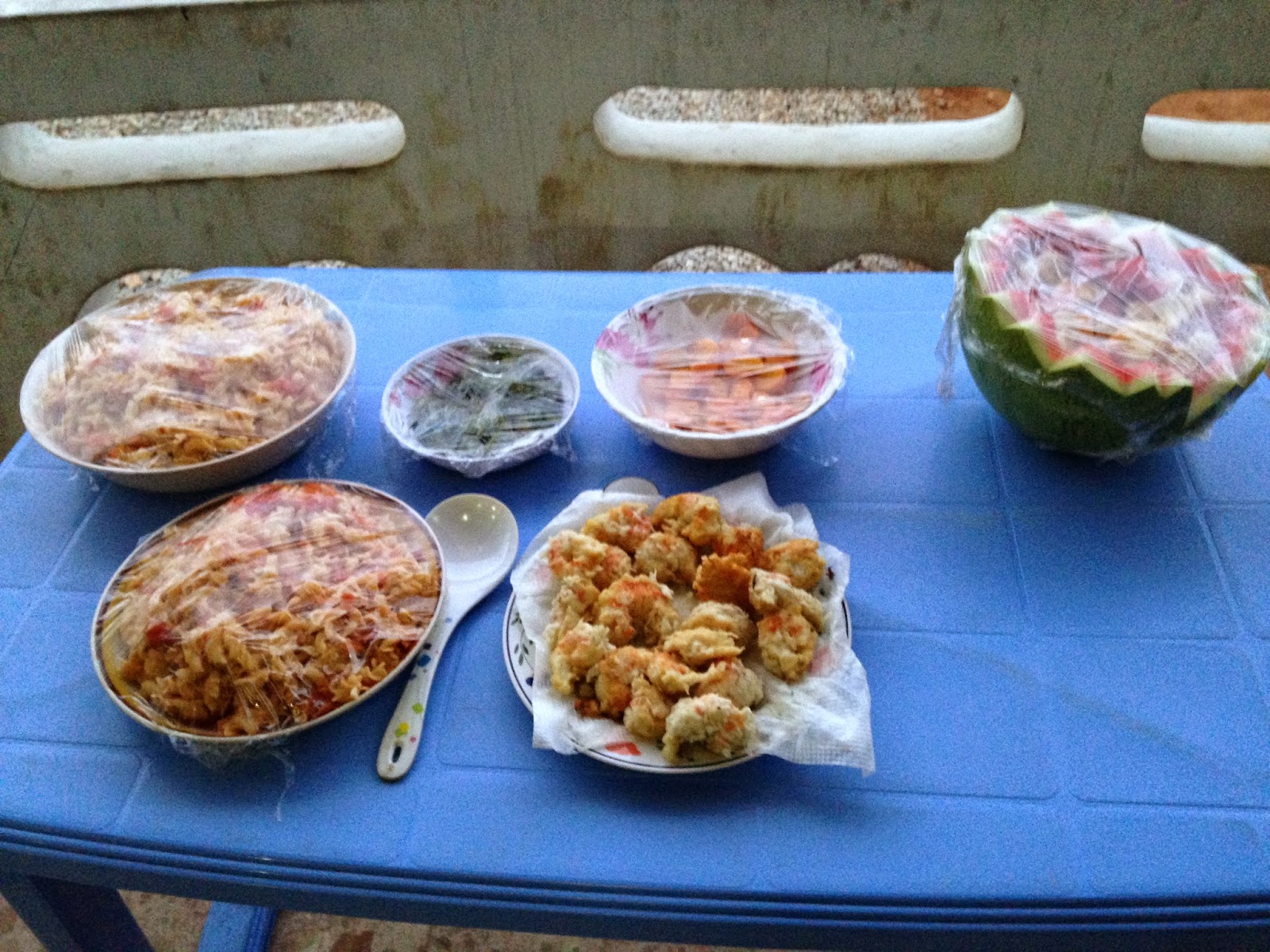
Here’s a look at everything that we had:


Not everything was as delicious as I could get it at home, but for the cooking of college and med students, it was pretty good. There were some dishes that the staff we cooked for (read: Aziz and Frances, the interpreter) made a face at trying (more specifically, the guacamole and the seeds for our tomato dishes), then lied and said they liked it. It’s a crucial part of Ghanaian culture to do that, but it’s difficult for Americans to understand that fundamental cultural gap. We’ve come to accept it by now, but it doesn’t make the practice any less weird. Plantain chips used for the guacamole was a genius idea, even if the dip needed more salt.

We decided to make banana splits only after everyone finished eating to prevent the ice cream from melting. We wanted to flambé the bananas and used the rum that we’d bought from the supermarket to cover the bananas. Our many attempts to set the rum on fire in the banana pan were not very successful, but it actually was pretty cool to have a faint alcoholic taste in the sweetness of the banana split; I think that the bitterness of the bit of rum was excellent in bringing out the sugar of the chocolate spread, which I was worried about because it wasn’t very sweet to begin with. 

Between the meal and dessert, the seamstress that had come to take our cloths and measurements on Thursday night brought back our clothes, and we looked so, so cute in our custom-made Ghanaian clothes!


We ended up hanging out pretty late after that, and the Germans were being great sports in playing games with us. The saddest part of the night was the fact that Rachel, who is the US-born in-country director of GB Ghana, was staying at Aaba Lodge tonight, and she didn’t allow loud music to be played. Kwame, one of the cleaners and managers of our lodge, had specially gone to his house to bring his speakers to play loud music for us to dance to, and was really disappointed when Rachel came because that meant he couldn’t use them. It was emotional to think about how our relationship with him (and the other GB staff!) had evolved and developed so much over the course of the three weeks we’d been in country.


It would have been a great day if it had ended there, but it didn’t; the reality of having to go back to our lives and responsibilities in the States hit some of us, especially one intern who found out that her boyfriend had cheated on her with her best friend right before she left for Ghana from a third party. It turns out that alcohol has its merits – it can really connect people in a way that nothing else really can, and empower people to make decisions that they would otherwise be too timid to make otherwise. But tonight, it was clear that it is often an escape – something that allows the consumer to get away from problems and reality and just have a good time. She drank way too much and threw up. Luckily, someone else was really great at making sure it was cleaned up and took the rest of it into the bathroom, but it just makes me remember the risks you take when you decide to pursue happiness for yourself. The happier you are, the more it kills you when (or if) it falls apart. At one point in the night, she said that best friends don’t exist. I can’t even imagine. 

Ghana Day 20; 8/22/14

We woke up ridiculously early today to get to community to paint our latrines and make sure that the families we were building for understood how to take the best care of it. We were told to wake up at 6am to eat breakfast and be ready to leave by 7am, but when that is said, we all know that it’s not actually going to be the case. At the earliest, we might leave by 7:20, but 7:30 or so is much more likely. The interns and Deanna call it “Ekumfi time” as a joke.

When we got to the community before 8am, there were a good number of kids running around already. One of the first things that we saw was this adorable concrete block on the ground that one of the kids from the house had made:


We then mixed the paint that we needed to make the design that we agreed upon, which was white on top and blue on the bottom, blue polka dots on the white background. It turned out to be really great, and the kids that we’d gotten to know came around and helped us paint, which was really cute.


It turns out that I have a really memorable name or something because a lot of the kids remembered it and came to play as the morning went on, and it was a little crazy to think that there were so many children that we interacted with over just the past three days. I had some time to play with them, and one of the (the same one from yesterday) braided my hair again. Interacting with the kids was really cute today especially because one of the interns was really sloppy with paint and got it all over the rest of us, but the kids started trying to get it out of our hair and off our skin.

Right before we left, the girl who braided my hair asked me to bring her “biscuits” (I think she means cookies) if I come back. Aww.

When we finished the latrine, this was our final product:


We made sure at the end that we could talk to the family we had built for about maintenance of the latrine. It was surprising to see that everyone else wanted to jump straight into the instructions and forgo formalities like thanking the mother for letting us work with her family. After we’d done that, we started explaining to her how to make the most of her latrine (families pay 250 GHC). That included not throwing toilet paper or excess water into the latrine to help the sewage pit last longer, the fact that the waste from the pit can be taken out after 15-20 years when it is full to use as fertilizer, and that Global Brigades will fix anything that has gone wrong for only the first three months after construction. She ended up giving us some watermelon and other fruits as a thank you as we drove away for the last time.

After lunch, we headed to the Global Brigades Ghana office to give our final presentations for the internship in front of some of the key staff of GB Ghana. It was a little intimidating because the economic development interns (Ed, Noah, and Megan) gave a really great presentation about their proposal to create cooperatives in different communities to increase the impact and sustainability of latrine building and the construction of a soap factory in Ekumfi Egyankwaa. I hadn’t ever heard a business proposal presentation before, but it was awesome to hear the business students present because they have skills that I’ve never learned about, can draw on facts and figures, and explain to help a layperson understand. Those are acquired skills, but it was obvious that there was a difference between their presentation and the global health ones.

The nine global health interns decided that we would present in three groups, each of us talking about a different aspect of our internship and our suggestions for it. I think that all the groups, mine included, probably should have spent more time preparing for the presentation overall, but I didn’t think that anyone did a poor job of portraying the general consensus about our stances on different issues.

The thing that made the presentation difficult and stuck with me for a while was the fact that there was one GB professional who was new to the organization and had not yet been briefed about how everything works. Our presentations assumed a basic understanding of what we did and our subsequent recommendations, and he seemed to be very interested in everything and wanted to grill my team especially about our suggestions for the medical brigade portion of our internship. I’d forgotten what it was like to have to think on my feet like that about a topic other than myself (for a personal interview, for example), and it was hard for me to keep on my feet. Though I was complimented on my handling of the questions and the other GB staff members that were directors and other people like that helped answer questions, I felt like I’d left a lot on the presentation stage. It’s not a good feeling, but I guess it reminds me of how important it is to keep up my skills. One of the coordinators asked my group for our presentation via email afterwards, which was really awesome.

Another group that presented made a joke about their coordinator for the public health brigade not helping them, which did not go over well with the GB higher ups. They immediately wanted to know who it was and what exactly it was that he didn’t do, but the group was just joking because he helped more with directing the ladies in his group rather than the manual labor itself. The cultural differences between the presentation group and the audience created the gap awkward situation in which a joke was misunderstood, but I’m intrigued to learn more about humor and how it varies according to culture.

Throughout the program, we were given Coke in a bottle (!) and meat pies, which was a surprising combination. I didn’t particularly like either one, but when in Ghana, you take what you can get.
Afterwards, we had a little bit of a photo shoot:


At night, we split everyone (including the 6-people German brigade that was constructing latrines) into 3 groups to decide what we were going to buy from the market tomorrow to cook for everyone (us and the staff). My group of 6 decided to make banana splits and a fruit salad with an alcoholic refresher, and then I had some time to talk to Kristoff, one of the German medical school students. When we were trying to think of how much of each ingredient we would need, he kept checking if we knew how much a kilogram or liter was, which was simultaneously funny and adorable. It was so fun to talk to him because the Germans in general are so classy. They eat everything with a fork and knife, all know more than one language, are polite, quiet, respectful, adventurous (they’re staying in Ghana for 4 weeks after their brigade!), and are eager to ask and answer questions as they come. It’s refreshing to meet them and be able to see a little bit into their world without the pressure of having to be the expert on America or seeing them as the experts on Germany because we’re meeting in Ghana.


He was saying that he took a year off after high school to work in Italy so he speaks fluent Italian before going to medical school. He’s going to his 4th year out of the 6 that are required for a degree (they don’t have undergraduate/graduate distinctions). He likes to snowboard, and he did tae kwon do and skied before that, but he’s never tried yoga. He lived in the States for a year when he was 4 or 5, and has traveled to both the East and West coasts a lot just to visit. His favorite city out of all the ones he’s visited (it sounded like a whole lot) is San Francisco, which makes sense because it’s not as busy as a NYC or LA and has a certain classiness to it, and he said that it’s probably the closest to Europe that you’ll get in the US.