La Paz has turned me into an adrenaline junkie, apparently, because today was spent on the Death Road. The name sounds more daunting than the activity actually is (for the most part), and it's worth one day if you have it to spare.
I talked a little yesterday about booking this tour for 360 Bs while I had other offers for 700 and 750 Bs, so to say the least I was a little nervous about what this would be. Again, my worrying was for naught. Before I describe my day, let me explain what exactly the Death Road is.
According to my guide today, Max, it's one of (if not the) deadliest roads in the world because of its narrow sections and the fact that it winds down a mountain in the Amazon rainforest. The location is about an hour away from La Paz, and tours spend the whole day (about 7 am to about 7 pm) taking groups here. You basically go with a group to the beginning of this trail, which has two parts. The idea is that you bike down and it's incredibly exciting because of all the bumps along the way. You practice for about 30 minutes, getting used to the bike over paved road first. When you're ready, you get back on the bus, which takes you uphill until you get to the second part, which is the actual adrenaline-pumping, focus-or-fall portion over the dirt road. This part takes about 2 hours, and at the end you go to a hotel with a buffet for lunch, hot showers, and a pool. You get to chill for a while before heading back to La Paz.
Everything went relatively smoothly, which is great. I was picked up from my hotel at about 6:50 am and taken to the travel agency to pick up my helmet, gloves, jacket, pants, etc. I met the other people who would be in my group then - 3 Israelis, 1 German, and 3 Chileans. It made for a nice group, with 4 Spanish speakers (the German lady learned Spanish after about 6 months of travel in South America) and 4 English speakers. I was worried at first because I have been on previous tours (ie Puno's Lake Titicaca islands) where the mix of English and Spanish tourists decreased the quality of the tour for both parties, but I was lucky that this was not the case. Right away, I could tell that Max did a great job with both languages.
We started off at a little lagoon. It was quite pretty and a nice place to have some breakfast, even at 4700 meters above sea level. We tried on our bikes and gear and headed off!
The paved portion of the road was nice and very, very pretty! I should have appreciated the lack of bumping more at the time, but that falls into the category of things I didn't appreciate until they were gone, unfortunately.
The second part of the road was simultaneously fantastic and extremely difficult. The dirt roads, with tons of random rocks and bumps everywhere, did not make it easy to ride over. Every single meter was a journey, and I had to balance trying to mitigate feeling the bumps by letting my hands and my legs feel the brunt of it. As I'm writing this now, my palms are aching, my butt hurts a little to sit on, and my arms are a little tingly, but it's definitely worth it!
What makes the trip more difficult than the constant bumps is the transition from early-morning cold to Texas-summer hot as you move down the mountain. It makes it hard to know what to wear, but I powered through with several layers of basically half the clothes I brought with me to South America.
We ended the trail and headed to the hotel after we finished, and thankfully they had towels, a hot shower, and even shampoo as well as the nice buffet for lunch. We then spent time lounging by the tiny little pool before heading home!
The way home took about 3-4 hours, especially due to traffic in La Paz (dare I say it's worse than Austin's?!). Along the way, Max sat with us in the back after two of the Chileans took another bus somewhere. He was white, which I noticed before but didn't question until he shared that he was originally from France and moved to La Paz about a month ago after staying in it while visiting several countries around South America. He learned Spanish, built a social network, and found a girl, so he decided to stay - it helped that he loved the city too. It was kind of awesome to see that he could give tours in Spanish after learning it so recently. He also said that he has heard really great things about Austin, so that was cool!
When we got back to La Paz, I stopped by the travel agency to get the pictures our other guide took of us and walked back to the hostel to pick up my bag before going to the bus station for Cochabamba! I wonder if it'll be as nice as I expect to stay in one place/have a home base for about 6 weeks, and/or to have a travel buddy for a little bit (shout out to Daniel, coming at the end of the month!). It'll be extremely different from the sort of travel/backpacking that I have done so far, so I'm excited!
Thursday, June 11, 2015

Wednesday, June 10, 2015
6/10/15: La Paz
It's been a good day! La Paz has all the downfalls of a big city - smelly at times, messy, 100% chaotic - but also has a lot of the benefits - great markets, walkability, and awesome things to do.
I woke up pretty early and went to eat breakfast - pancake buffet! They also had tea, coffee, and actual cold milk. Quite the miracle. I had some pancakes and milk tea and started my day.
The hostel at which I am staying is next to a pretty major street in the city. It's always busy, and during rush hour, it gets a little crazy. What I like about the street is that is has overhead crossings for pedestrians so they don't have to try to navigate themselves, and have random patches of little gardens everywhere. I found a little plaza of art that was tucked away in a corner, but it seems to have used recycled metal to make sculptures of various animals.


I walked to a main square, where the city's main church is. Pictures of the interior were not allowed, and overall the city doesn't come alive until about 11 am, so it was relatively quiet but very pretty. The inside of the church itself is much like every church I've seen in Peru, but the square outside is attached to a rather large market that I went to explore as well. Again, it was very quiet and most shops were closed, but there were lines of flower shops open with all sorts of gorgeous bouquets that I wouldn't mind receiving.


I planned to take a guided tour at 11, so I had over an hour to spend. I walked around the area some more and booked a Death Road tour for tomorrow (more on what this is in tomorrow's post!). Note about this - the hostel advertised a tour for 700 Bs, and another agency told me their offer was 750 Bs. I actually booked a tour through this tour agency next to the church for 360 Bs - we'll see if that was a mistake or not. In my experience though, things usually work out. TBD.
The cool thing about the random gardens in the middle of the main street is that you can see gems like Christopher Columbus - who doesn't deserve statues of commemoration, come on - in between a random bank and a hotel.

The tour itself was really great! We started off in another plaza (La Paz seems to be teeming with them) that was next to the San Pedro prison. Apparently the prison is famous for its drug culture (and creativity with smuggling), and people who are accused are sent to live there - even before they are convicted. People are considered guilty until proven innocent, but they can also bring their families to live with them to make things easier. The prison environment is a mini city in itself and doesn't have any guards inside - that would make it a perfect candidate for social science research if it were ethical.
We then walked through the regular market (on weekends in its prime, 5 streets shut down across 6 blocks to make room for everything). Apparently people tend to pick one seller and stick with them, and then get the benefit of the best produce/meats/products and a trusted adviser.
The tour led us to the main church and adjoining market again, but thankfully it was worth the trip because the plaza had a small group of what looked like indigenous people dancing, and the market had livened up. We stopped for some food, and I bought this peeled potato that was stuffed with meat, carrots, onions, and some sauce and then fried on the outside. It cost me 6 Bs (less than $1) and was delicious. Seriously, that thing is so genius.


We also went to see the witch's market, which apparently has all kinds of weird things. Llama fetuses (more creepy than you can imagine, but randomly hanging along the streets, eww), potions, and "witches" walking around approaching people and reading their fortunes. Our guides explained that llama fetuses are apparently used in building foundations as an offering for stability, and that certain potions have legendary effects (the "Follow me follow me" will have the object of your affection following you home if you blow some of the powder on the back of their neck, and the "come to me come to me" will help someone want to sleep with you). I'm not so sure about the consent aspect of these potions, though.
Our next stop was the actual main city square because it was next to the Presidential Palace. Our two guides talked about the tumultuous political history of Bolivia - including setting the Guinness World Record for most coup-d'etats in the shortest period of time. Apparently, presidents have been killed, kidnapped, hung, and otherwise brutally removed from office/publicly displayed in the area. It was quite disturbing, and a lamppost in the main square (from which one president was hung to his death) held a bullet hole from a shootout not to long ago in the area over political power again. I'm just glad that's not an issue now.
The last stop was a tavern where we were given a traditionally Bolivian shot (it tasted like 90% orange juice, 10% alcohol otherwise I wouldn't have had it), and a further explanation about the current Bolivian president in the more private place because freedom of speech is not as far-reaching here as it is in the United States and Western Europe. Apparently, he has done some good things for the country's development, but has also done things to try to increase the Bolivian population like trying to outlaw condoms, taxing women 18+ without children, giving bonuses to women under 18 with children, etc. Hmm.
I then went to something called the Urban Rush. Basically, you are tied up to a rope/pulley system and can rappel down 17 stories of the side of a building. You can also do a little bit of free fall during the last part. It's not overly expensive (I did it twice), and is a lot less nerve-wracking when you've actually done it! 100% terrifying at first, but without a doubt is worth it. It was super fun!
I was told that I needed some warm clothes for the Death Road tomorrow, so I decided to finally go buy a scarf. I spend the next hour or so shopping, and bought 2 cute and reversible hats for 35 Bs (comes out to about $2.50 each) and a scarf for 18! I am super excited for these.
There is a huge park that was blocked out in the map that I have of La Paz, and I wanted to go see it. When I arrived, however, it didn't seem that great except for a small amusement park in the center of it. I wasn't sure how it worked (entrance ticket, pay-per-ride, etc.) so I didn't go in. I was also running out of time before sunset, so I went to try to buy a bus ticket to Cochabamba instead. I had asked a random employee in the bus station about a ticket yesterday, and was told around 65 Bs. I went into two travel agencies today who told me 140 and 150. When I went to the actual bus station, I got one for 30 Bs. Granted, it's probably not the most comfortable I could have - we'll see tomorrow. But seriously, that price difference? Hmm.
Last thing of the day was Mi Teleferico - the cable car system. It works a little like a mini subway system. There are many different lines but they mainly are at the edges of town. There was a station (red) about 3-4 blocks from my hostel, so I walked to the station and took the cable car up. Since La Paz in the valley of many mountains, the routes go from the edges of the valley to the top of the mountains. As a result, they give spectacular views - and since I went right as the sun was setting, they were made even better by the sunset. Also, did I mention the round trip cost 6 Bs, or less than $1?
Dinner was street food - What? Why would you eat street food? Don't you know you're going to get sick?! - Well, okay. That is a possibility, but street food is the closest you get to what people actually eat, and it's also dirt cheap. I got this hamburger and a generous serving of fries for ONE DOLLAR. Also, it was delicious and filling. And I don't regret my decision at all.
I woke up pretty early and went to eat breakfast - pancake buffet! They also had tea, coffee, and actual cold milk. Quite the miracle. I had some pancakes and milk tea and started my day.
The hostel at which I am staying is next to a pretty major street in the city. It's always busy, and during rush hour, it gets a little crazy. What I like about the street is that is has overhead crossings for pedestrians so they don't have to try to navigate themselves, and have random patches of little gardens everywhere. I found a little plaza of art that was tucked away in a corner, but it seems to have used recycled metal to make sculptures of various animals.


I walked to a main square, where the city's main church is. Pictures of the interior were not allowed, and overall the city doesn't come alive until about 11 am, so it was relatively quiet but very pretty. The inside of the church itself is much like every church I've seen in Peru, but the square outside is attached to a rather large market that I went to explore as well. Again, it was very quiet and most shops were closed, but there were lines of flower shops open with all sorts of gorgeous bouquets that I wouldn't mind receiving.


I planned to take a guided tour at 11, so I had over an hour to spend. I walked around the area some more and booked a Death Road tour for tomorrow (more on what this is in tomorrow's post!). Note about this - the hostel advertised a tour for 700 Bs, and another agency told me their offer was 750 Bs. I actually booked a tour through this tour agency next to the church for 360 Bs - we'll see if that was a mistake or not. In my experience though, things usually work out. TBD.
The cool thing about the random gardens in the middle of the main street is that you can see gems like Christopher Columbus - who doesn't deserve statues of commemoration, come on - in between a random bank and a hotel.

The tour itself was really great! We started off in another plaza (La Paz seems to be teeming with them) that was next to the San Pedro prison. Apparently the prison is famous for its drug culture (and creativity with smuggling), and people who are accused are sent to live there - even before they are convicted. People are considered guilty until proven innocent, but they can also bring their families to live with them to make things easier. The prison environment is a mini city in itself and doesn't have any guards inside - that would make it a perfect candidate for social science research if it were ethical.
We then walked through the regular market (on weekends in its prime, 5 streets shut down across 6 blocks to make room for everything). Apparently people tend to pick one seller and stick with them, and then get the benefit of the best produce/meats/products and a trusted adviser.
The tour led us to the main church and adjoining market again, but thankfully it was worth the trip because the plaza had a small group of what looked like indigenous people dancing, and the market had livened up. We stopped for some food, and I bought this peeled potato that was stuffed with meat, carrots, onions, and some sauce and then fried on the outside. It cost me 6 Bs (less than $1) and was delicious. Seriously, that thing is so genius.


We also went to see the witch's market, which apparently has all kinds of weird things. Llama fetuses (more creepy than you can imagine, but randomly hanging along the streets, eww), potions, and "witches" walking around approaching people and reading their fortunes. Our guides explained that llama fetuses are apparently used in building foundations as an offering for stability, and that certain potions have legendary effects (the "Follow me follow me" will have the object of your affection following you home if you blow some of the powder on the back of their neck, and the "come to me come to me" will help someone want to sleep with you). I'm not so sure about the consent aspect of these potions, though.
Our next stop was the actual main city square because it was next to the Presidential Palace. Our two guides talked about the tumultuous political history of Bolivia - including setting the Guinness World Record for most coup-d'etats in the shortest period of time. Apparently, presidents have been killed, kidnapped, hung, and otherwise brutally removed from office/publicly displayed in the area. It was quite disturbing, and a lamppost in the main square (from which one president was hung to his death) held a bullet hole from a shootout not to long ago in the area over political power again. I'm just glad that's not an issue now.
The last stop was a tavern where we were given a traditionally Bolivian shot (it tasted like 90% orange juice, 10% alcohol otherwise I wouldn't have had it), and a further explanation about the current Bolivian president in the more private place because freedom of speech is not as far-reaching here as it is in the United States and Western Europe. Apparently, he has done some good things for the country's development, but has also done things to try to increase the Bolivian population like trying to outlaw condoms, taxing women 18+ without children, giving bonuses to women under 18 with children, etc. Hmm.
I then went to something called the Urban Rush. Basically, you are tied up to a rope/pulley system and can rappel down 17 stories of the side of a building. You can also do a little bit of free fall during the last part. It's not overly expensive (I did it twice), and is a lot less nerve-wracking when you've actually done it! 100% terrifying at first, but without a doubt is worth it. It was super fun!
I was told that I needed some warm clothes for the Death Road tomorrow, so I decided to finally go buy a scarf. I spend the next hour or so shopping, and bought 2 cute and reversible hats for 35 Bs (comes out to about $2.50 each) and a scarf for 18! I am super excited for these.
There is a huge park that was blocked out in the map that I have of La Paz, and I wanted to go see it. When I arrived, however, it didn't seem that great except for a small amusement park in the center of it. I wasn't sure how it worked (entrance ticket, pay-per-ride, etc.) so I didn't go in. I was also running out of time before sunset, so I went to try to buy a bus ticket to Cochabamba instead. I had asked a random employee in the bus station about a ticket yesterday, and was told around 65 Bs. I went into two travel agencies today who told me 140 and 150. When I went to the actual bus station, I got one for 30 Bs. Granted, it's probably not the most comfortable I could have - we'll see tomorrow. But seriously, that price difference? Hmm.
Last thing of the day was Mi Teleferico - the cable car system. It works a little like a mini subway system. There are many different lines but they mainly are at the edges of town. There was a station (red) about 3-4 blocks from my hostel, so I walked to the station and took the cable car up. Since La Paz in the valley of many mountains, the routes go from the edges of the valley to the top of the mountains. As a result, they give spectacular views - and since I went right as the sun was setting, they were made even better by the sunset. Also, did I mention the round trip cost 6 Bs, or less than $1?
Dinner was street food - What? Why would you eat street food? Don't you know you're going to get sick?! - Well, okay. That is a possibility, but street food is the closest you get to what people actually eat, and it's also dirt cheap. I got this hamburger and a generous serving of fries for ONE DOLLAR. Also, it was delicious and filling. And I don't regret my decision at all.
Tuesday, June 9, 2015
6/9/15: From Copacabana to La Paz
Today was very, very chill. I basically didn't do anything because my bus to La Paz from Copacabana was at 1:30 pm and there wasn't anything else to see in Copacabana. I went to the main square to sit and read a little, then finally bought a SIM card for Bolivia. It was a struggle figuring out how this new carrier, Tigo, works because it's different from Claro, the carrier I used in Peru.
I had lunch at the same place I did on day 1 in Copacabana because it was cheap and relatively delicious - though I tried out the wifi today and it was basically like not having wifi. That's pretty much been my experience thus far in Bolivia - the wifi speed is so slow that you can barely load anything. That is, if you can access the signal in the first place. Honestly, it's getting on my nerves. I need wifi to communicate, to get around, to do research (on attractions to visit, etc.), and to work! The lack of internet I experienced in Copacabana meant that I couldn't use Fiverr the whole time, and just those two days were bad. Seriously, I know that access to internet is supposed to be a luxury, but it's definitely a necessity for me. I don't need constant access to it, is the thing. I just need a reliable connection (one that doesn't take a hour to publish a page) for a couple hours a day. Is that too much to ask for?
Anyways, the buss ride wasn't too bad. Halfway through, we were asked to get out, pay 2 Bs for a boat ride across a section of Lake Titicaca (the bus itself was also taken on a boat across the Lake, it was quite the sight), and get back on. I did not enjoy nor appreciate that very much, but I got over it.
I arrived in La Paz at around 5 pm. The bus station is more organized than anything I saw in Peru, which is a good thing. Apparently buses to Cochabamba, my volunteer and next site, are frequent, which is good. I think one costs around $8, according to the one lady I asked, but I will ask around more tomorrow. It was very smart of me to screenshot a little map to the hostel I wanted so I could walk two blocks to get there and not hire a taxi.
The hostel is less than ideal. It's large, which is nice because there are a lot of other people. However, the only place with tables is the bar, and even though there are "No Smoking" signs, it smells like cigarettes and makes me want to punch someone. It also has music that is overly loud. Ugh.
On the bright side, the rooms themselves are quiet and do not smell like smoke. They also cost 49Bs, or just over $7 a night, which is good enough for me. The wifi, though terrible, at least exists. Good enough, I guess. Hopefully tomorrow will be a nice day because today has just been ehh.
I had lunch at the same place I did on day 1 in Copacabana because it was cheap and relatively delicious - though I tried out the wifi today and it was basically like not having wifi. That's pretty much been my experience thus far in Bolivia - the wifi speed is so slow that you can barely load anything. That is, if you can access the signal in the first place. Honestly, it's getting on my nerves. I need wifi to communicate, to get around, to do research (on attractions to visit, etc.), and to work! The lack of internet I experienced in Copacabana meant that I couldn't use Fiverr the whole time, and just those two days were bad. Seriously, I know that access to internet is supposed to be a luxury, but it's definitely a necessity for me. I don't need constant access to it, is the thing. I just need a reliable connection (one that doesn't take a hour to publish a page) for a couple hours a day. Is that too much to ask for?
Anyways, the buss ride wasn't too bad. Halfway through, we were asked to get out, pay 2 Bs for a boat ride across a section of Lake Titicaca (the bus itself was also taken on a boat across the Lake, it was quite the sight), and get back on. I did not enjoy nor appreciate that very much, but I got over it.
I arrived in La Paz at around 5 pm. The bus station is more organized than anything I saw in Peru, which is a good thing. Apparently buses to Cochabamba, my volunteer and next site, are frequent, which is good. I think one costs around $8, according to the one lady I asked, but I will ask around more tomorrow. It was very smart of me to screenshot a little map to the hostel I wanted so I could walk two blocks to get there and not hire a taxi.
The hostel is less than ideal. It's large, which is nice because there are a lot of other people. However, the only place with tables is the bar, and even though there are "No Smoking" signs, it smells like cigarettes and makes me want to punch someone. It also has music that is overly loud. Ugh.
On the bright side, the rooms themselves are quiet and do not smell like smoke. They also cost 49Bs, or just over $7 a night, which is good enough for me. The wifi, though terrible, at least exists. Good enough, I guess. Hopefully tomorrow will be a nice day because today has just been ehh.
6/8/15: Isla del Sol in Lake Titicaca
Well. I don’t even know how to describe today.
I guess, since today is day 21 on the road, that I got
complacent. With the exception of that one day in Ica my first week, I’ve
actually been getting along very well. Today, instead, was another roller
coaster of a day – with highs and lows much more extreme than that taxi ride in
Ica.
So, I was excited today. I was going to visit the Isla del
Sol in the middle of Lake Titicaca and have a blast doing it (even at about
4000 meters above sea level)! The day started with a south Asian man walking
the street leading up to the beach with a couple pastries, offering them for
sale, and looking at me asking where I was from. “The United States,” I said.
“Oh. But you look Chinese,” he responded.
Oh. Do I really? For real? Are you sure? Ugh. Yes, I know I look Chinese. That’s my heritage. It’s not like I’ve looked
Chinese for my entire life or anything. You know. And then he introduced
himself as Bangladeshi, not local. Well. I'm just not sure how that's relevant.
Everything in the morning went smoothly as I boarded the
boat towards the island. It took a while to get there (about two hours) and I
had a little bit of motion sickness, but the Lake was beautiful and there was a
cute little five-year-old boy that kept talking the whole time.


We arrived at the north part of the island and started
walking to the northern tip of the island, which had some ruins of a small
scale. There was a Spanish-only guide that was leading us through, and I could
catch a little bit of what he was saying. It was kind of nice of him to point
things out, but he was not up front in saying that his guidance would cost us
10 Bolivianos each. In fact, I was a little upset that he didn’t tell us, added
to the fact that I didn’t really understand him anyway. And then I realized 10
Bs was less than $1.50, and then was a little upset at myself that I was upset
about spending that amount on someone who can have half a meal with that, and I
can earn that much relatively easily. It was a complex feeling.


Anyways, we checked out the ruins, and there is apparently a
rock that looks like a puma. It’s a little hard to see, but the front part that
is indented in represents the mouth, and the part to the right is the rest of
the head. The part to the left is the puma’s body – it’s abstract but if you
pay close attention you can sort of see it.

There were also several mini, mini ruins that we walked through – they reminded me of a tiny model of what I saw at Ollantaytambo.


After that, the guide walked back to our starting point and
I walked alone towards the south of the island. It took me about 2.5 hours (8
km or 5 miles) to walk, so I was pretty happy with my time, getting there
around 3 pm.
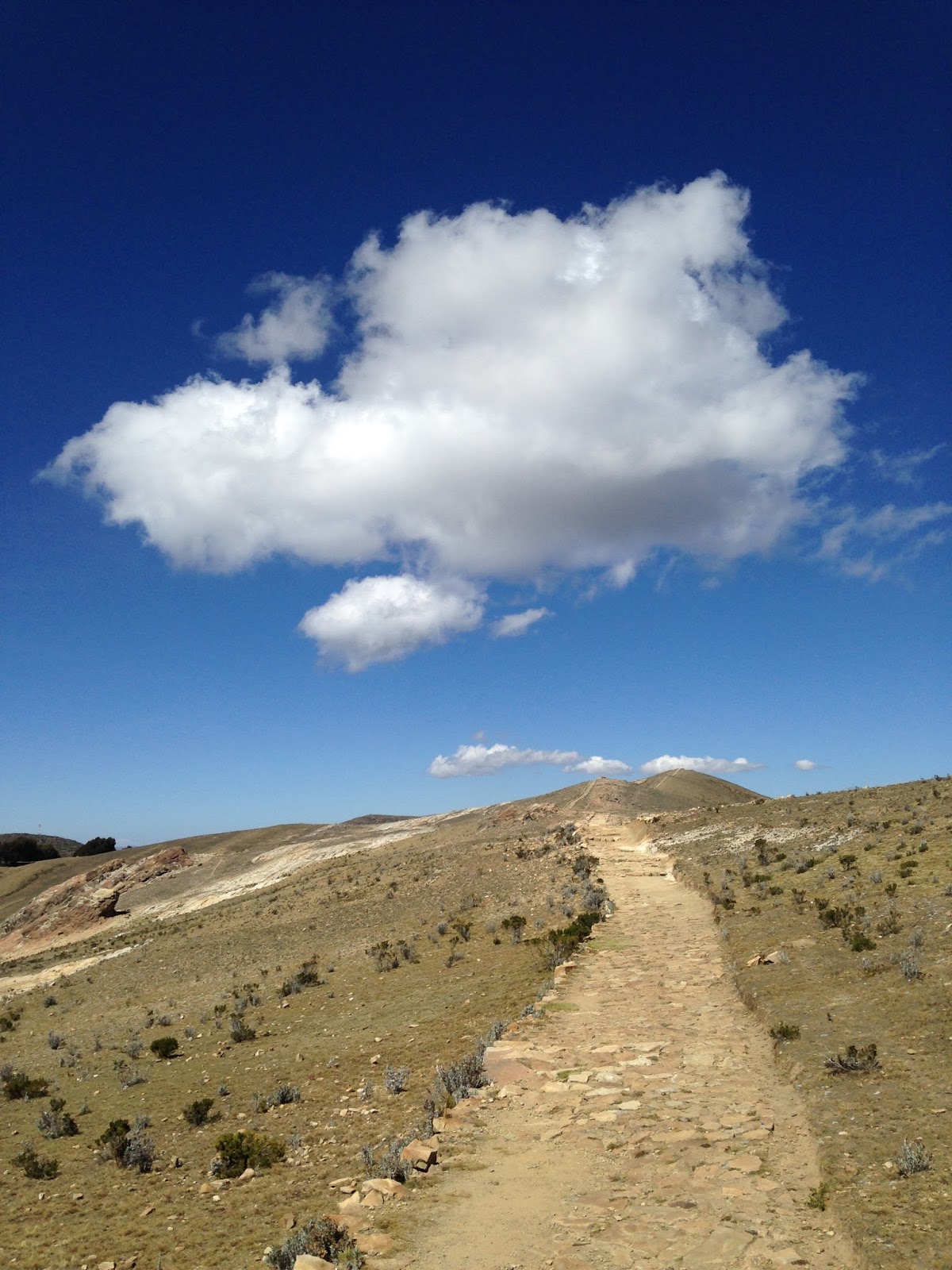


I could catch the boat back to Copacabana at 3:30 right
there, or could keep walking south to get the boat at 4. I felt adventurous and
didn’t have much else to do, so I decided to keep walking to the southern tip
of the island. The area was extremely unclear, but I thought I saw a
foreign-looking guy walking in one direction, so I decided to follow.
At this point, I should have realized that I could no longer
see him, and ask a local where to go. The streets were relatively empty,
though, so I decided just to keep walking. I went about 15 minutes, and looked
over the cliff to see a single tourist-looking boat. I didn’t see any other
people, but I thought it was just because I was about 40 minutes early. I
didn’t see any clear paths down to the boat, so I started along a trail but
eventually decided to start walking through the terraces to get down faster. I
remember thinking to myself something like, “Thank god I’m going down and not
up because this would be impossible the other way.”
Well. Ironically, I got down to the bottom of the cliff to
the Lake, and the pathway to the boat was blocked off by a wall with a barbed
wire-covered door with a lock. I thought that was weird but luckily there was a
young girl – maybe in middle or high school – that I asked for help. It turns
out that I was in the wrong place completely.
Instead of continuing to head south, like I should have, I went north. By this time it was around 3:45,
and I panicked a little. She told me I just had to go back up the mountain and
take the road that would lead me directly to the port I was looking for, Pilkokaina,
and said that it would probably be fastest to walk instead of try something
else.
At this point, I have been walking for about 3.5-4 hours,
and I’m tired. Looking back up at the mountain, I don’t know if I can walk all
the way up there and then around again, and I’m terrified because I have 15
minutes to make it to the port. I usually consider myself a rational person,
but as I made my way back up the trail-less incline, I started to cry. The
absurdity of my entire trip to South America was called into question in my
mind – here I am, a 21-year-old student from the United States who barely
speaks Spanish, girl, traveling alone, on an island that I’m unfamiliar with,
about to miss a boat, with a little shoulder bag of stuff, running out of
water, in the middle of these terraces where the closest hostels or even local
houses are far away.
But I kept walking, because what the hell else would I do?
There was a little white building that said something about
“Salud” and “Isla del Sol” about ¾ of the way up the mountain, so I knocked on
the door. This nice lady opened it, and led me into the main room that had two
other ladies. They had a map on the wall, but when I told them I needed to get
to Pilkokaina by 4 pm, they had a pained look on their faces. They told me I
would have to keep walking up the incline to the “main road” and walk left, and
it would take me 30 minutes, more or less. I could walk, they said, but it was
3:55 and it was basically impossible for me to make it in time.
At this point, I was coming up with all kinds of contingency
plans in my mind. Maybe I would go and there would still be a boat waiting –
you never know with South American time. Or maybe I could get there by hiring a
little rowboat of a local. If I’m really
desperate maybe I could swim there. Is that an option? Perhaps I would consider
literally sleeping out in the open for the night, on a terrace for free. At
least then I could see the stars. I didn’t want to stay the night on the island
because I wanted to go back to my hostel and take a shower and eat a nice meal
and have access to all my stuff, and I just hate the idea of paying for
something I wouldn’t use – like the hostel room for the night.
On my way continuing up the mountain, I actually just broke
down, lying on the ground and cried for about 30 seconds – I didn’t want to
waste any more time than that. I kept walking, making sure to verify my
directions with locals that I saw along the way, and then crying when I
couldn’t see them anymore. At the point where I could see the port, I also saw
two large boats driving away. I felt a sinking feeling because I knew that
those were probably the last touristic boats that were leaving. The 30-minute
estimate was actually longer than that – it turned out to be closer to 45
minutes when I got to the port itself.
There was only one boat docked at the port with someone near
it. He was cleaning it, and had been since I could see him from the top of the
mountain. I was prepared to offer him money to take this boat to Copacabana for
me. What gave me hope was that I saw four people and a guide walking down the
same path I was walking along down towards Pilkokaina, but I still wasn’t sure.
Anyway, I got there and was prepared to see if I could get a
ride back to Copacabana. I asked him, and he explained that it might be
possible, but this boat was a private one for the tourists that I had seen on
the path that went into a small structure before I passed them. He wasn’t sure.
But, he said, he would be happy to ask them when they got down here. It was possible.
I cannot describe to you how it felt to hear him say that in
the moment. Honestly, if he had said no, I’m pretty sure I could have figured
it out. I would have just spent some extra money and stayed at a local hostel –
I’m sure I could have gotten a room for 30 Bs or less. But the relief I felt in
knowing that there was a real chance
that I could make it back to Copacabana today was overwhelming, and I just sat
down on the dock and cried. It was half embarrassing, half relief. I think the
guy didn’t really know what to do, but he told me to calm down and that it
would be okay. He asked if I was traveling alone – yes – if I had a bus ticket
– yes, to La Paz, but tomorrow – what boat company I had booked with, whether I
knew I should have been there at 4 pm – and he was actually very reassuring.
I’m sure he didn’t think he would meet a young Asian girl crying on his deck
because she didn’t want to ask how to get to a port. Ugh.
Anyways, I was allowed on the boat. One girl offered my
tissues and another asked me if I was okay and offered me a coca candy. I
honestly kept crying for a total of about 15 minutes, and then got a hold of
myself. When we arrived at Copacabana, I was so relieved and felt like I just
survived a night in the Maze Runner maze like Thomas and Minho that one night
from the book. Ugh. Emotionally exhausted.
I walked into a little place that had a fixed menu like
yesterday, except they served fried fish instead of chicken. Good enough, and
it was a relief to access internet a little bit (even if it was exceedingly
slow) and eat. Quinoa soup, and dessert was this little pancake with some ice
cream that tasted a little like banana. Ironically, a bottle of water there
cost my 8 Bs, while the meal itself was 20 Bs. I guess I know where they make
their money. But whatever, I had run out of water and in total the meal was
still just over $4.

The high of the night was walking out of the restaurant and
bumping into a lady that I had met yesterday on the bus from Puno. Right before
we got to the border of Peru and Bolivia, the bus stopped at a money exchange
place to allow us to get Bolivianos if we needed them. What happened with her
was that she was given a 20 soles bill from the Puno bus company, but the
exchange place claimed that it was counterfeit when she tried to get Bolivianos
for it. She was pretty angry because it wasn’t her fault, and the employee kept
trying to defend his company when the exchange lady tried to get her money
back. It became a little bit of a mess, and when we left the border area, I
didn’t see her on the bus. I didn’t know what happened to her until she told me
the story tonight.
Apparently, she had decided to go back to Puno to this bus
station. She found the lady that had sold her the bus ticket and told her that
the bill she was given as change was counterfeit. Drama ensued, and the lady
started called my bus companion a liar and a cheat and crazy and everything,
but apparently she remembered the details of their transactions, which was
suspect. Anyway, my bus companion ended up staying the night in Puno and filing
a police report in the morning, and then standing in front of the company’s
desk at the bus station telling people not to buy from them because they are
liars and cheats. It took about 3 hours to get the police report completely
filed against this woman – during which the police tried to give my bus
companion 20 soles to get this over with – but she was more interested in
justice than the actual money itself. LOL
It was actually nice to get lost in another story after the
nightmare this afternoon. As I’m writing down the day’s happenings tonight, I
don’t really know how to feel. On the one hand, I’m a little proud that I
didn’t give up on the boat, but I’m a little ashamed that the episode even had
to happen. On the other, I’m laughing at the money story – 20 soles is less than
$7. And it erupted into this big thing. I’m not sure how I feel right now, but
I think I’m okay. As long as that’s the case, I really have nothing to complain
about.
6/7/15: Copacabana
It’s been another long day! Including today, I’ve actually
woken up earlier than 7 am on 7 of the past 8 days, and that one anomaly I woke up at 9:30. This is severe change from
what I am used to, and is quite a struggle. I think I am getting used to it – I
don’t really need an alarm anymore to wake up at 6 am, but I wish I could just
get more sleep. Sigh.
I was a little nervous about the trip today because I have
never crossed a border by land and did not have anything booked before I got
here. I had no Bolivianos (the Bolivian currency) and I would not be able to
use my SIM card, and I have heard that wifi and internet are just not very good
in general in Bolivia, at least as compared to Peru. Luckily, most things
worked out okay. The taxi came to bring me to the bus station (where I had to borrow
1.5 soles from a taxi mate due again to no cash – ugh), and then I successfully
got on the bus to Copacabana. For some reason, the bus that was scheduled to
leave at 7 am did not leave until 8 am, which was annoying. There was a young
couple (younger than me) from Colombia sitting in the seats across the aisle
from me that kept making out and putting their hands up each other’s’ shirts
and I just – UGH. THIS IS PUBLIC.
Anyways, the border crossing was actually super chill and
I’m pretty sure you could get around it very easily. There are two stations –
one for each country. You go to the Peruvian office to turn in your tourist
card and get your passport stamped, and then walk across the border to get your
Bolivian tourist card and passport stamped. Technically, this all happens in
buildings off the main road so you could pretty easily just not go to either
one – not that I recommend it.


Upon arrival to Copacabana, I was approached by a lady
waiting at the bus station advertising her hostel. She told me it was about a
block from the main square and she could let me stay for 60 Bolivianos for two
nights. I bargained it down to 55 which is the cheapest that I have heard from
people who have been here before (yay!). She also promised hot water showers
and wifi, but I haven’t seen either one of those. Oh well, you get what you pay
for (the exchange rate with dollars is about 6.91, so I’m paying about $3.98 to
stay here per night. LOL the electricity and bathroom access pretty much covers
that cost). I’m actually staying in a nice room with just three beds – and the
other two are empty. It’s quite nice, actually. The bed is comfortable and the
blankets seem thick enough. It’s a little far from the beach and port for the
Lake Titicaca islands from this town, but it’s okay.
Copacabana is small enough that you can just walk around and
see the whole thing. There are two little “main squares” that I saw, the
biggest one is connected to this rather majestic church.

I then went to withdraw from Bolivianos from the ATM, which
actually doesn’t charge an ATM fee! Even though I get any and all reimbursed by
Schwab, I still have to wait until the end of the month, so this no-fee thing
is a pleasant surprise! I think I’m going to take out a little extra cash to
make it easier on myself down the line.
I then went down to the beach – the road there is lined with
touristic restaurants, travel agencies, and souvenir shops. At the port, the
Lake is beautiful!

I then went to the Museo del Poncho – a cute little textiles
museum that outlines the different designs of ponchos and clothes from the Lake
Titicaca populations. They are overall gorgeous, but some of the full outfits
were awesome! Flashy at times, and just enough color at others.


The only other real attraction in Copacabana is called Cerro
Calvario – it’s a small collection of crosses at the top of the hill that
overlooks the town. It took about 45 minutes to walk up, but the point had some
beautiful religious art and even better
views of Lake Titicaca. Seriously, it is breathtaking
from there!


I had some dinner (really delicious quinoa soup, fried
chicken/rice/fries, and chocolate syrup bananas) for just 20 Bolivianos, or
about $2.89. This pricing this is brilliant. If I ever run out of money I just
need to move to Bolivia for a couple months and all will be well!


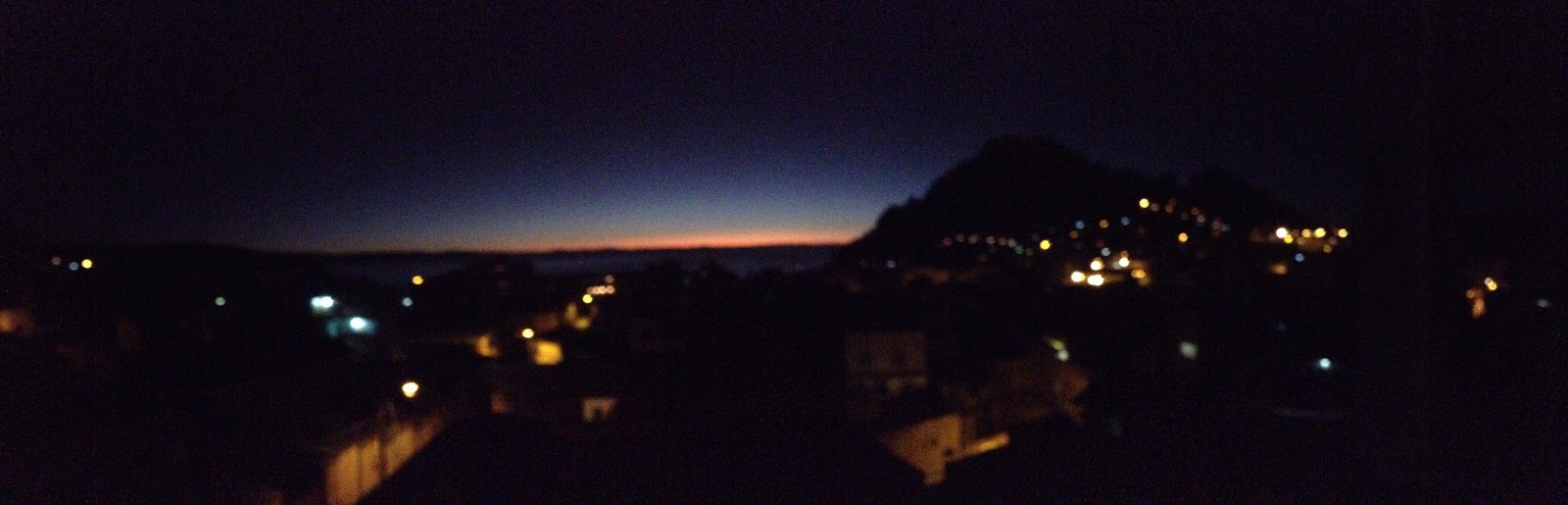
Last thing today – beautiful sunset!
Tomorrow’s itinerary: boat to Isla del Sol from the north,
walking to the south, and then back. Apparently there are some great ruins on
the island, some native/indigenous cultures, and a pretty museum.
Unfortunately, I’m looking at about 4 hours of walking and about 5-6 hours on
my feet, so hopefully it will not be too bad. On the bright side, I’m not
feeling so sore today!
Saturday, June 6, 2015
6/6/15: Lake Titicaca from Peru
I woke up at another ungodly hour today (about 5:50 am) to shower since there was no water last night. The breakfast was good, and I waited nervously again to ensure that the tour I had booked yesterday would be honored. Luckily, I was!
We arrived at the port of Puno, where we were put on a boat towards the first of the two islands that we would explore today in the Lake Titicaca, or highest navigable lake in the world. Honestly, it's beautiful! The part near the city of Puno has a lot of algae in the water and it not as pretty, but the part that is closer to the islands is truly gorgeous when the water is clear.


Our first stop was the Uros islands - these are nearest to Puno. When we arrived to just one of about 100 islands in the group that makes up Uros, we met the community president. The island we saw had only 5 families, so it was really small but this president did a great job in explaining the process of building the island. Essentially, the ground is made of two parts and is about 2 meters deep. The bottom is packed soil that contains roots of reeds. They are anchored by reeds that are growing on the bottom of the lake (this area of Titicaca is rather shallow) so they don't float away. On top of this soil block are layers and layers of alternating horizontal and vertical reeds, piled on top of each other. This provides a softer ground to stand on. He had an adorable little model that got a chuckle out of all the tourists.




We arrived at the port of Puno, where we were put on a boat towards the first of the two islands that we would explore today in the Lake Titicaca, or highest navigable lake in the world. Honestly, it's beautiful! The part near the city of Puno has a lot of algae in the water and it not as pretty, but the part that is closer to the islands is truly gorgeous when the water is clear.


Our first stop was the Uros islands - these are nearest to Puno. When we arrived to just one of about 100 islands in the group that makes up Uros, we met the community president. The island we saw had only 5 families, so it was really small but this president did a great job in explaining the process of building the island. Essentially, the ground is made of two parts and is about 2 meters deep. The bottom is packed soil that contains roots of reeds. They are anchored by reeds that are growing on the bottom of the lake (this area of Titicaca is rather shallow) so they don't float away. On top of this soil block are layers and layers of alternating horizontal and vertical reeds, piled on top of each other. This provides a softer ground to stand on. He had an adorable little model that got a chuckle out of all the tourists.


The inhabitants of the island then took us on a boat tour,
which was nice and peaceful. Two of the little toddler-age girls insisted on
coming along, and the whole time they were climbing all around the two-deck
boat and talking to each other and the people who could speak Spanish. They
were absolutely adorable.


The problem for today was that I had only about 55 soles
left, and since I’m leaving for Bolivia tomorrow (they use the Boliviano), I didn’t
want to take out any more money. I set aside what I needed to pay for my
hostel, but I got on the boat before I realized it was 10 soles. After paying
that, I was left with about 11.5 soles, which I thought could last me.
We walked around the island a little, though it was tiny –
about half the size of a basketball court. There was barely anything on it – 6 houses,
a little ancestor’s teepee thing, a restroom, a lookout perch, and a little
outdoor kitchen. The center was empty/filled with water and not for people to
walk in. It was so interesting to see their lives, where children take little
boats as taxis to school and the adults jump in the Lake for bathing and
washing. They have so little and yet they can have a good time. It’s truly
fascinating.


We then got back on the boat to head towards the other
destination for the day, Taquile Island. This one is a lot larger than the Uros
island that we saw – it has about 2000 inhabitants, and its textile art was
named a UNESCO World Heritage product in 2005. What makes it unique is that
inhabitants traditionally wear their special clothes to signify their
marital/relationship status. For example, married men wear hats with one type of pattern. Unmarried men wear another, and its position on his head signifies whether he is single and in school, single and graduated, or in a relationship. I can only imagine what it means for the "Define the Relationship" talk, lol. Women wear shawls, and the size of the rainbow tassels on the corner signify their relationship status - large for single and coupled, small for married.


We then went to eat lunch. If I had known that we would all
be eating together for a fixed price, I would have just booked the tour with
lunch instead of without. The cool thing was that the guy who ran the little
restaurant out in the middle of nowhere on the island gave us a demonstration
on a plant that they could grind up and mix with water to make a sort of
natural shampoo! Lunch was delicious – grilled/fried trout with rice, potatoes,
and beets. The problem was that I was asked to pay 20 soles – and I had
only about 11.5 on me. I had no idea what to do, but luckily a girl that I met
offered to spot me the rest, so I’m extremely thankful for her and for that!


After lunch, we had to walk to the Taquile city square. Along
the way were houses, animals, and agriculture, which is the main economic
activity on the island. The city square was very small, with basically a
tourist shop, a restaurant, a great view, some random shops, and the city
council meeting place. What made it nice, though, was a beautiful view!


On the way to the boat were these gorgeous arches that
framed the Lake in the background in a way that was just absolutely stunning. One
other tourist pointed out that he thought the cover of the Lonely Planet
guidebook for Peru was taken from Taquile, and I’m pretty sure he’s right. Seriously,
it’s beautiful.


That was my day! Pretty chill, about 6 hours of it spent on a boat, unfortunately, but Lake Titicaca from Peru is quite pretty! I'm going to Bolivia tomorrow, starting with Copacabana, where I will see the Lake from the Bolivian side. The trip is making me really nervous because I won't be able to use my phone there, and I also have no hostel/accommodations booked in Copacabana. I don't know what the wifi situation will be either, so this will be quite the adventure - I only hope that it will work out for the best. Wish me luck!
Subscribe to:
Posts (Atom)