Sunday, August 17, 2014

Ghana Day 14, 8/16/14

I have severely underestimated the prevalence of alcohol and how deep the love for it runs. Every night except the first night they were here, the medical brigaders from Loyola have cleaned out the alcohol fridge, and last night, when they made a drinking game out of entering data informatics about their brigade patients. Each time they came across a patient with malaria or other diseases, they would cheer and drink. It was tacky and while I understand that it’s not fun to enter data into a computer, it’s also very disrespectful to make a game out of it.

Today was another free day, so we spent the morning in the market in the nearby city/town. We’d stopped at the entrance of the market many times before, but I didn’t realize just how expansive the area was until we walked through it.


Overall, their market seemed a lot like the night market in Taiwan combined with a farmer’s market and the urgency and crowdedness of a Chinese market. As we walked through it, we could see all different stores along the sides, selling things from fabrics to jewelry to fresh produce and fish. There were so many different things that you could buy, it was almost overwhelming. And the thing is, the streets were very narrow, so we would have to walk single file to effectively move from one area to the next, and letting other people pass by when we wanted to stop and look at a stall was a little uncomfortable. Nevertheless, I bought some really pretty fabric with sparrows on it and some jewelry, so I was really happy with my purchases. Honestly, I had forgotten how fun it is to spend money.

A couple observations to note:

  • ·         Once again, there were a good number of people that called Ed and me, “China.” I’m still curious as to the existing knowledge about Asia and why they assume that everyone is Chinese. One seller even went as far as to say 你好(hi in Chinese), which surprised me a lot! But I smiled and said it back.
  • ·         They sell both fried (cooked in oil) and fresh fish, but since most people only have the means to cook their fish in oil, I wonder why they have both.
  • ·         The shopkeepers will flirt with you shamelessly or shove stuff in your face to get you to buy from them.
  • ·         The clothes that they sell look they were taken from Goodwill.
  • ·         They have flies everywhere on their food and no one actively tries to keep them away, so I hope they have great cleaning procedures (but I doubt it).
  • ·         The same designs on cloth are sold in almost all fabric stalls


After we’d bought what we wanted, we came back to the lodge to eat before heading out again to a pool. It was part of a resort that looked extremely classy and beautiful and I’ll let the pictures speak for themselves.


We were able to walk along the beach a little bit and explore:


When we came back to the lodge, we were able to try fufu, a traditional Ghanaian dish that is a lot like mochi, but not sweet. The mochi-consistency food can be put into any kind of stew for flavoring, and by itself doesn't have much flavor but could be quite good. When I tried it, however, it was in fish stew with a ridiculously strong taste of fish (my Mom cooks it with ginger to lessen that taste, always), and I couldn't eat more than the small bite I'd taken. I wouldn't be opposed to trying it in a different context, but it was not very good with the fish.

Saturday, August 16, 2014

Ghana Day 13, 8/15/14

Even though today was meant as a work day, we really did very little. The posters that we created from yesterday were made into presentations, which we used to present to each other and Deanna in the morning. I thought it was interesting to see how different perspectives can take the same information and form completely different projects; while my group focused on existing issues, target audiences, methods of education, and resources to help us with the education. The group that had the poster that was most different from ours was organized the information with a roadmap based on the dissemination of knowledge, and all the details fit under one of those categories (like existing knowledge, gaps in knowledge, etc.)

When it was lunch time, I think we were all disappointed to see plantains and beans/chili (without meat) being served. I’m usually not one to complain about food because I understand how privileged I am to always know that I will have access to it, but our diet here largely consists of rice, beans, tomatoes (in the form of sauce, usually), fries, and fruit (the white pineapple, mango, watermelon, and non-GMO bananas are quite delicious). It’s not much different from what is eaten in the communities that we are trying to serve, which is cool. Getting used to the limited choices and eating the same things multiple times in a week is less cool, and plantains and beans are our least favorite meal, collectively. It’s not terrible, but definitely not my meal of choice.

We were supposed to spend the afternoon entering the information that we gathered from our medical brigade into the data informatics system, but the guy that was supposed to teach us how to do it was mysterious MIA. Because we understood the cultural norm of a lax schedule (things that are scheduled to start at a certain time means that’s not actually going to happen until at least 20 minutes after), we waited for him for a couple hours. When it seemed as if he wasn’t going to show, we went “to the beach” instead.
I put that in quotations because we actually ended up going to the beach resort and sitting on lounge chairs that overlook the beach, with a beautiful view but not an obligation to get near the water. Some of the interns ordered food and drink and we spent several hours just admiring the view.


When we got back, we started to clean the sand off our clothes and feet for a while until we saw the members of the medical brigade that is living in the compound with us lining up for dinner. At least the rice and fries and fruit were worth it! The main reason that we now have to line up for dinner is because everyone wants to eat but there is a limited amount of food, especially those dishes that are most desired – like fries – and those tend to run out if you get there late.

We had no further agenda, so after it got dark and the power went out once again, all the interns gathered up on the roof to look at the stars. It was a very clear night and the moon was nowhere to be seen, so the view was absolutely breathtaking. I know that there are a lot of stars to be seen in suburban Austin where I grew up, but that view is nothing compared to what I could see on the roof. There were so many tiny lights against the midnight blue backdrop of the sky, and I could see the faint lights of what looks to be a galaxy of stars in the background of the individual stars. I’ve never imagined just how beautiful it really is or how low in the horizon these stars can go before they all disappear, and I’m disappointed that I couldn’t take any pictures. It was so easy to understand why we can't see that kind of view in the United States, because as soon as the power came on and the grounds were lit up, more than half of the stars were no longer visible. Combine that with the low levels of electricity and automobile usage, the clear skies make a lot of sense.

The kind of peace that comes with a view like that is unparalleled. 

Ghana Day 12, 8/14/14

We didn’t start our day today until almost 10am, but we drove to the Global Brigades head office so that we could start data analysis of the key informant interviews that we conducted with the three professionals we talked to about women’s reproductive and sexual health. I haven’t done very much qualitative analysis before (all my experience was with the Natural Sciences College Tuition and Budget Advisory Committee information to write our report last year), so I was interested in learning how to effectively conduct qualitative research. With our notes from the key informant interviews we did, we printed them out, read them over and highlighted the key words and phrases from them.

We cut out the phrases that we liked from the papers and organized them into several categories regarding the issues to solve, methods to solve them, and outlets to target to help us. We put together a poster that turned out really well for how little direction we had for it in the beginning, and I’m really happy with the way it all turned out. J


The one thing that did bother me about the activity is that it seemed like we were wasting a lot of resources that could have been easily conserved. Instead of editing the interview notes only after everything is physically printed, we should have edited the notes digitally and printed out only what we thought was most important. That would have saved about 100 sheets of paper. We put everything on poster board as well, which is also unnecessary considering we are to make a PowerPoint presentation from our posters to present that information anyways. Now that I’ve been to so many communities that have so little, including ones where the kids continually ask for pens, I want to be extra mindful of the resources that I use. I have always watched what I use, but I think that the stark contrast of actually using these materials while just a walk away from communities that never use that much paper is something that makes me think about my actions more carefully.

Deanna told us that you usually do a minimum of 12-15 up to about 35 key informant interviews and tried to find more subjects for us to interview (including community members themselves as well as professionals from other organizations that were helping the cause).


We had a lot of free time after we got back, so the rest of the day was very chill. It included a power outage that was pretty long, and I don’t think I’ve mentioned yet but the electricity supply is not constant here; if the demand for electricity exceeds the supply, a power outage results. We have to wait until the generator kicks in to have power again, and the gap can range anywhere from a minute to about half and hour. Luckily, we have electronics and flashlight apps on our phones, but it makes me wonder how people who live in some of the communities we visit cope because they only use their electricity to power their lights and not much else. 

Friday, August 15, 2014

Planned Parenthood Association of Ghana

Planned Parenthood Association of Ghana (Michael Tagoe)
History
Started by volunteers when people were giving birth to as many children as possible
·         Women are celebrated if they could give birth to 10 kids with a goat slaughtered in your name
·         Does not take into account that these children have to taken care of
·         Most houses in Ghana only have one room, so children have to sleep in the same room and can easily transmit communicable diseases
·         If women do not give birth to at least 10 kids, they are shamed in society
1967 – Several medical doctors and registered nurses start to provide education about family planning and giving birth by choice rather than chance or cultural norm
·         Challenges: misconceptions surrounding family planning and birth control, especially as they were seen as a white concept
1969 – Officially established PPAG in association with the IPPF (International Planned Parenthood Federation)
·         Started in greater Accra, continued to expand
·         Started to employ full-time staff, not just volunteers
·         Volunteers own the association, but staff have the expertise to make things happen
1999 – PPAG moved to focus on adolescent health
·         Formed young clubs in schools for learning about reproductive health issues
·         Left out young people who were not in school (who are actually the most vulnerable)
 “Young and Wise” organization was established as a specialized youth education system
·         Head office in Accra
PPAG is in 9 of the 10 regions in Ghana (lacking one due to ethnic conflict) but services are extended to that region
·         30% of the highest decision-making body is youth representation to show that PPAG is a youth-centered organization
PPAG Cape Coast
Has been in the current office since 2002 after an expansion and engages in several outreach initiatives
Global Comprehensive Abortion Care Initiative (CGACI, since 2009)
·         Purpose: to prevent unsafe abortions, which can lead to infertility and death
o   Women used to grind up glass bottles and drink it, eat all kinds of herbs, try to stick something into the cervix, etc. to get rid of unwanted pregnancy
·         Methods of operation
o   Train peer educators
o   Hold radio discussions on all Cape Coast stations
o   Run interviews on National TV service
o   Give out bikes to clients who refer the most friends
o   Period free clinic days (provide services and education)
·         Results from January to June 2014 in Cape Coast facility alone
o   1156 comprehensive abortion care services
o   8793 family planning services
Abortion laws in Ghana
·         Officially illegal
·         Can be legal IF
o   Pregnancy resulted from incest, rape, or defilement
o   The fetus has gross abnormality
o   The birth will affect the mental and/or physical health of the woman
·         3rd condition expands the legality of abortion a lot, and includes situations under which women do not want their child
·         PPAG can operate if the mother is within the first trimester
Global Fund (since 2010)
·         Purpose
o   Operates in 36 precints in Ghana, mostly in the Central and Western regions
o   Works with Ankagul and Sekondi prisons
o   Focuses on peer education of topics such as HIV/AIDS, STIs, etc.
o   First program to work extensively with prisons
o   Current challenges include a shortage of the reagent for HIV test kits and treatment, but prisons and pregnant women have priority for the test kits when they are available
·         Methods of operation
o   1-on-1 and small group discussions
o   Film shows on HIV education and stigma reduction
o   HIV testing and counseling
o   Advocacy and town hall meetings
§  Can discuss topics such as providing special diets to prison mates who are HIV+
o   Peer educator meetings to discuss successes and challenges
o   Distribution of hygiene kits to prevent sharing of toothbrushes, toothpaste, razors, etc.
o   Group discussions for education of prison officers’ children
·         Results from January to June 2014
o   3356 patients provided with HIV testing and counseling
o   23628 patients provided with peer education on STIs and education about the implications of sexual activity
National Strategic Plan
·         Purpose
o   Partnership with Cape Coast Polytechnic (college) with a focus on HIV/AIDS education
o   Peer education is managed by a Project Management Committee with 2 professors, 1 radio station representative, 1 student representation, and 1 peer educator representative)
·         Methods of operation
o   Radio and debate discussions, sometimes led by peer educators
o   Stigma reduction activities
o   Speakers about being HIV+
o   1-on-1, small, and large group discussions
·         Results from January to June 2014
o   862 students educated
o   59 students tested for HIV
o   Time given by professors to speak to students before and after classes
o   Free radio air time on the radio station, which reaches beyond just the college
Free Family Planning Project
·         Purpose
o   To provide free family planning services for the Yamoransa community
o   Collaboration with the Population and Health Department of the University of Cape Coast
·         Methods of operation
o   Announcements made via the community PA system
o   Van publicity
o   Doo-to-door and church-to-church publicity
o   Outreach clinic
·         Results from January to June 2014
o   689 contraceptives provided
Leadership Development Program
·         Purpose
o   A 6-month challenge to address a specific issue (like reproductive tract infections) in specific community (senior high school students in 4 schools)
·         Methods of operation
o   Trained school nurses, counselors, educated students, and clinical sessions
·         Results from January to June 2014
o   Four months in, 111 out of 151 students identified with RTI have been treated
o   2,058 students have been educated about RTIs and STIs
o   Outreach to all schools
o   “Corn Mill Project,” where people living with HIV can make corn meal from kernels to fund drug purchases and healthy meals; provides a community
o   Antenatal classes with demonstrations for pregnant women, caretakers, and husbands
§  A common practice is to drip boiling water into an infant girl’s vagina to heal a “sore,” which ends up wearing down the hymen covering and can lead to infections and other health problems
Sometimes partner with DOVVSU (the Domestic Violence and Victim Support Unit from the Ghanaian police)
For Muslim families, women want birth control but men do not
·         Women will sometimes get birth control and keep it a secret from the men
·         Main educational point is to empower women to stand up for themselves because they are the ones that bear the majority of the challenges of childbirth
·         Muslim women actually use PPAG resources the most
Minors wanting abortions must have an adult’s consent, but it doesn’t have to be a parent
For older women, no other consent besides the personal one is needed
Any abortion techniques used in PPAG are approved by the WHO

Emphasis on the importance of systematic and continuous education

Ghana Day 11, 8/13/14

Most of our day today was spent having fun and being a tourist in the city, and I’m sure that it was a much-needed rest day. Before we had that, however, we had a meeting at the Planned Parenthood Association of Ghana in Cape Coast, the city we were visiting.

I had no idea what to expect from the presentation, but I am pleasantly surprised at all the information that was presented to us from a full-time staff member named Michael Tagoe. He had a lot of details on the kinds of programs and outreach that the facility did along with specific measurements of the reach of the work. I really liked listening to the information and it reminded me how much I have grown to be an advocate for women’s rights and empowerment. I’ll type up the notes that I have for a different blog post, but it was amazing to see how passionate a young man (probably early 30s) was about a woman’s right to choose, as well as the innovation and grassroots-level work that he was in charge of to advocate so much for women in the communities.

A couple things worth mentioning about our visit to PPAG are that (1) they have amazing educational posters everywhere, spanning topics from HIV/AIDS transmission to proper hand-washing and (2) despite having a higher percentage of religious people in the surrounding communities than those in the US, they never have protests or riots about the comprehensive abortion services offered.


After we left the clinic, we headed to the Cape Coast Castle, which apparently was the fort at the very center of the slave trade during the 1600-1800s when that horrifying event was happening. I found it interesting that there was a Mormon church on the side of the road when we were driving because I thought that the Church of Latter Day Saints was purely an American religion, but I guess they’ve done a good job of reaching out to people of other countries as they do their required mission trips.

The view at the Castle was beautiful because it was right next to the ocean. It also overlooked a community that was bustling with activity and provided for some great color in pictures, but it wasn’t very large overall. The thought that so many Africans came out of this particular port and the controversy and taint on American history that came out of it was truly humbling and simultaneously disgusting. All the facts that I’d learned about the slave trade in school was made so much more real and tangible as our tour guide brought us through the corridors and dungeons and just made me feel really sick. It doesn’t matter to me that these gut-wrenching acts happened so many hundreds of years ago because the lack of sanitation just makes the conditions worse.


The first two are the Castle from the outside, the last picture is the drain inside the male slave dungeon

At the entrance of the male slave dungeon is a plaque that commemorates President Obama and the First Lady’s visit to the Castle back in July 2009, partially as a tribute to the Michelle’s ancestors. When we walked in, we could see the gently sloping floor (I assume this was preferred over stairs to make guiding the men that were shackled together easier and prevent them from falling and disturbing the whole process) go about 2 stories into the ground into three chambers. They are about the size of the dorm rooms connected to each other, but apparently could house up to 1000 men at once. It sounds like an absolute nightmare already, but the worst part is that the only light comes from tiny holes in the walls at the very top of the dungeon. There was a layer of decomposed human waste that we could see was at least 2 inches thick covering the whole ground. The only drainage system was a tiny little indent in the floor that ran to the ocean, but it was only of use when rain could come in from the pathetic windows at the top of the dungeon. Men would stay in these dungeons for 2 weeks to 3 months and eat twice a day as they waited for the ships to arrive to take them to the United States, Caribbean, and sometimes Brazilian coast.


I thought it was really ironic that the church that the soldiers worshipped in was right above the male slave dungeon.

When we saw the female (and children as young as 6) slave dungeon, I was surprised to see that it was ground-level with a huge window facing the inside of the castle. It used to have steel bars across the front of it like a prison, but the stark difference between the men’s and women’s dungeons, especially with respect to location (2 stories into the ground for men, ground level for women), is an interesting dichotomy. I think that, in a way, it reinforces the idea that the women were there mostly for reproductive purposes rather than to serve as viable slaves.


We also saw the punishment rooms for both the men and the women. For the men, it was a small room with no windows. The entrance has two separate narrow spaces that can be blocked off and a really low ceiling (I think this could be to help prevent revolts; the number of people that can access the entrance at once is limited, and the ones that can have to bend down to get through it). Men who are more trouble than they are worth are put there to die, and our tour guide said that it takes about 2 days to happen. The front chamber of the entrance is for soldiers who misbehave, but they are only there for a maximum of 24 hours and have access to food and water, which the slave men did not.


The women, by contrast, were put in their cell for 5 days. If they survive after being fed just once a day, they are reintroduced into the general dungeon and life continues as normal. Unlike the men’s punishment room, the women also had a hole in their cell for bodily functions and a little bit of ventilation.

There were also some graves for people who were important to the slave trade, including the first African man to be ordained as a pastor in the UK. He came back to the Castle to serve the 150-200 soldiers and was buried in the middle of the courtyard when he died, along with several other important officials over the years.


We also saw a water storage unit that went very deep that used to store the clean water for the slaves when they were kept here, along with the tunnel that led them from their respective dungeons to the beach shore. They were led out through a door that is labeled “Door of No Return,” symbolizing the official exit of their motherland and their transport to the Western hemisphere. When we went out it, we saw it labeled “Door of Return” from the other side, which was symbolic of the welcoming of the descendants of former slaves to the Castle.


There were several storage rooms for both the payment methods used in exchange for slaves (like textiles and gunpowder) and the exports they took (gold, ivory, and spices).

The governor of the Castle had a room that was about the size of one of the three dungeon chambers for the third of 1000 male slaves all to himself. It was separate from his bedroom, which was a size akin to a typical room in a suburban house in the US. He also had a liquor cabinet that looked to store more liquor than he could drink for a year, and all I could do was shake my head at the contrast between the room he had and the room the captured Africans lacked.


The most shocking part of the visit was our walk through the small museum that accompanied the Castle. There were some artifacts from the slave trade itself, but I was appalled that the current culture of the Akan people was buried behind the exhibit talking about the slave trade and the Europeans that came with it. Furthermore, I saw that the text acknowledged the deep scars that the European slave trade put on the continent of Africa (can we talk about colonization as well?), but it immediately transitioned to the benefits that the slave traders brought to the continent, citing the arrival of Christianity, new agricultural systems, the value and emphasis of formal education and literacy, carpentry skills, etc. It was 50-50 about the scars vs. benefits, but the benefits blurbs were much more detailed and descriptive. I was disgusted that there was so much praise for these concepts because the main reason that Africa has most of the underdeveloped countries is because of European exploitation since the beginning of time. I could not stand reading about the “upsides” of having Europeans pit ethnic groups against each other so that they would take prisoners of war to sell them out to them for gunpowder and textiles that are not worth human lives in terrible conditions. I get that many of the visitors to the tourist attraction are white – American or European – but I would rather the museum be for educating these visitors about just how bad this major part of history is and have them reevaluate the information they have received about slavery and the slave trade.

After we left the Castle, we had a couple hours to shop at the stores next to the ocean. We were able to buy some great souvenirs, and I’m really happy that I got them. We stopped at a paradise restaurant and bar that was overlooking the beach. I shared a grilled chicken dish with one of the other interns, and it was actually really delicious. The chicken was seasoned extremely well (it reminded me of the salt and sour chicken from Taiwan) and made me really miss eating chicken. Oh well. On the menu, they had several Chinese dishes (fried rice, eggrolls, etc.) that were listed under the appetizers along with a chicken sandwich. I thought it was hilarious that a chicken sandwich was listed under appetizers because we eat those as complete meals.

One of the interns also ordered a traditional Ghanaian dish, banku, which is something like cornmeal ground into a moist dough. It looked promising, but tasted a little like uncooked sourdough mix and made me spit it out right away. There was a stew that came with it that was apparently crucial to making it taste better, but I'm not sure anything could save it from the sour and bitter taste of flour.

Another note: in Ghana, they cut the top off of oranges and suck the pulp out rather than eating slices. I think it’s a little cleaner that way because you don’t get orange juices all over you, but I couldn’t get used to it.


Wednesday, August 13, 2014

London, Day 3 (8/2/14)

I meant to write every day, but the reality of it is that I've had 12-hour (or so) days walking around and on my feet for the past 3 days, so it's been difficult to find the energy. Nevertheless, as I'm getting ready to leave London, I can say that it is a wonderful city and definitely worth visiting!

I'll fill in Day 1 and Day 2 in London when I have some down time later on, but since I'd been so busy on those days and saw most of what I wanted to see, I decided that I could take it a little easier today. I woke up with really sore calves and feet (a product of walking so much), but it was nothing new. Before I left the hostel, I went to eat some breakfast. Because it was just before it was going to close, a lot of people were in the dining area and this one man took 3 of the hard-boiled eggs. It would have been okay if there were a lot left, but no, those were the last three. What kind of person does that?

Anyway, I first took the Underground (subway system) to the Olympic Park area that was the center of the action in 2012. I had completely forgotten that this was an option until it randomly popped into my head on Day 2, but I'm really glad I went. The area surrounding the main parks and facilities is really beautiful and a modern shopping area. It's very outlet-like, with live music and everything - and they have fancy water dispensers that are basically poles with an arm that juts out and pours water directly down into your water bottle. 

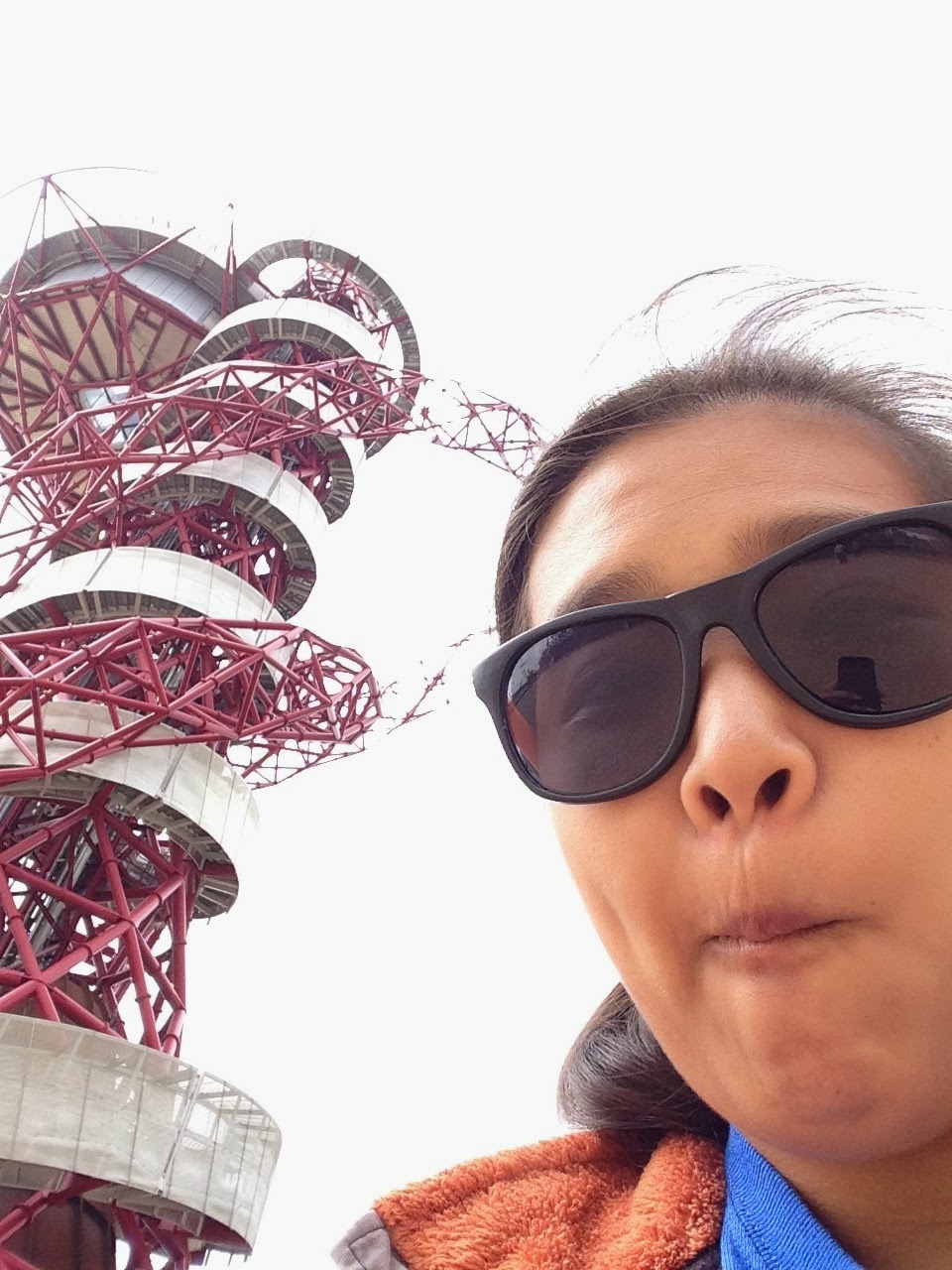
I had originally signed up for a tour of Olympic Park, but I was already about 5-10 minutes late when I got there and I had no idea where the tours were starting because the directions were "Across from the Aquatic Center," which happens to be extremely large, thank you. But no matter, because I got to see the London skyline (part of it) from the ArcelorMittal Orbit:


It's a really tall building that is designed specifically to be a tourist attraction. It opened in 2009 to prepare for the London Olympics in 2012, so it is very new. There is an elevator that will take you to the very top, where there are observation decks and interactive skyline displays and funky mirrors. I then chose to walk back down through the silver tube-looking thing around the red steel. It's lined with various speakers that play sounds from different places in the surrounding area (the park, the stadium, etc.).

On my way to Wimbledon, I stopped to get some Starbucks because I wanted to see if it was any different from the ones in the US. Everything is about 2x more expensive, and they sell "yoghurt" flavored with banana and red berry, but I got the "caramel creme," which is non-caffeinated caramel frappicino but looks like frosted milk. 


After I finally made it to Wimbledon, which is kind of in the middle of two Underground stations that are very far apart, I went on a tour to see how beautiful the grounds were:


They also have a great museum of Wimbledon and tennis history connected to the tennis club, and that is definitely worth checking out if you ever visit. 

After that, I took the Underground back to central London and started towards the London Eye, for which I bought tickets for a late night ride. I saw a lot of street performers as I made my way from the station to the Eye, but I didn't see any that caught my eye because I had a great experience watching some really talented street performer group when I visited New York City about 3 years ago. 

I arrived at the London Eye ticket offices early so that I could get the 4D experience beforehand, but I have to say it was a little weird. It was short (maybe 3 minutes or so?) and the animation/CGI followed a white bird into a "birds-eye" view of London. At times, we felt a soapy/bubbly liquid over us that smelled like bubble gum that didn't contribute to the experience, so I was really confused about it. Either way, there was a part where a child on the screen blew bubbles at us and another where a flare was coming out of the screen and it looked real enough for me to reach out and touch and duck from, which was cool. 

A couple pictures from my view of London from atop the London Eye:


It's so beautiful, isn't it? Even though I had seen much of the landscape already, I loved the nighttime/sunset view that I got.

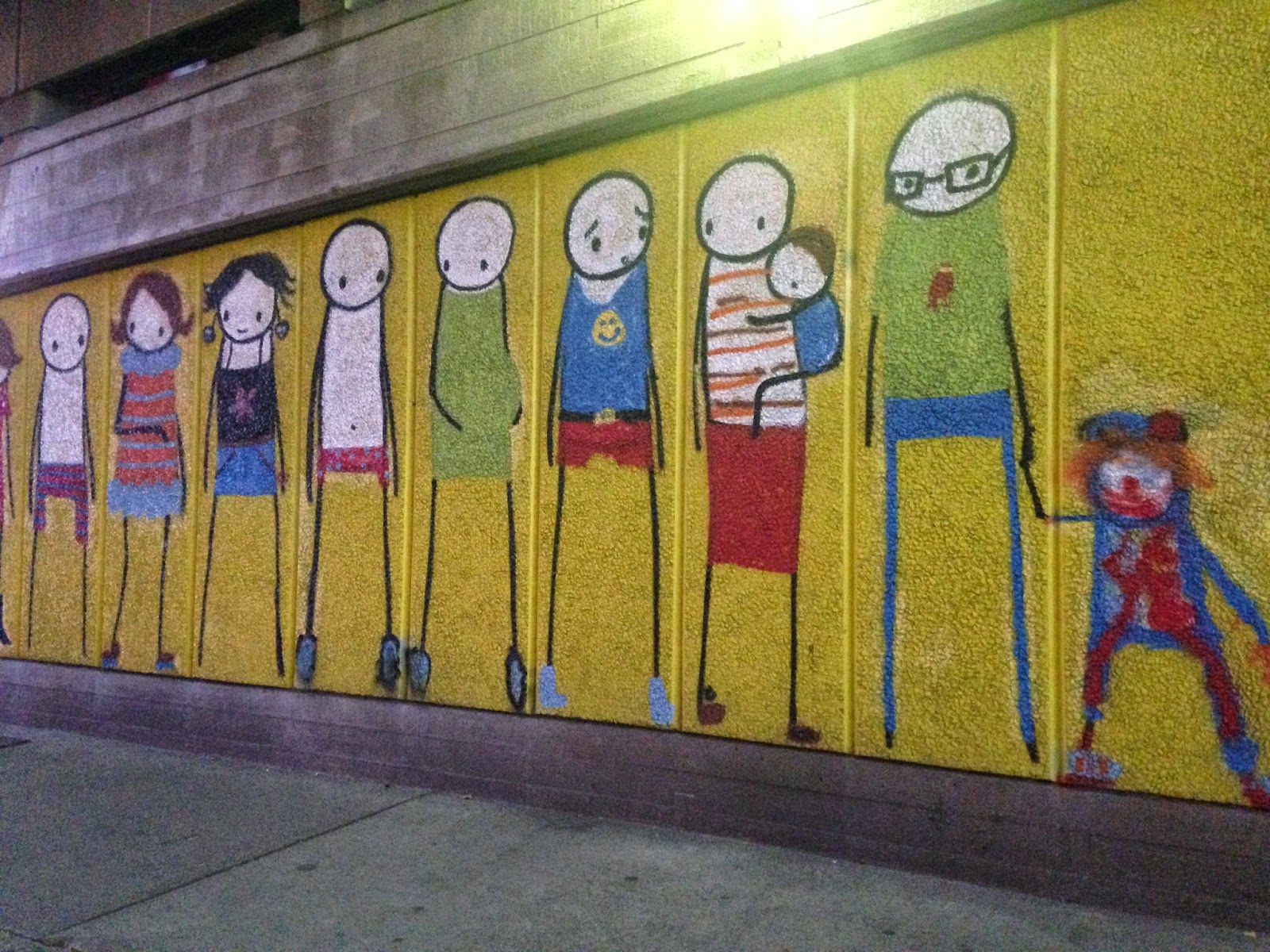
As I started to the nearest Underground station to go back to the hostel, I saw these cute paintings on the walls under a bridge:


I also saw several police figures leaning over a homeless man that looked to be motionless, but it turns out that he was just extremely difficult to wake up and was okay to go.

That concludes my time in London! I had a really fantastic time and was able to see a lot, and I'm sure I'll be back soon! I'm off to Ghana tomorrow morning, which is nerve-wracking and completely exciting at the same time, so we'll have to see how it goes!